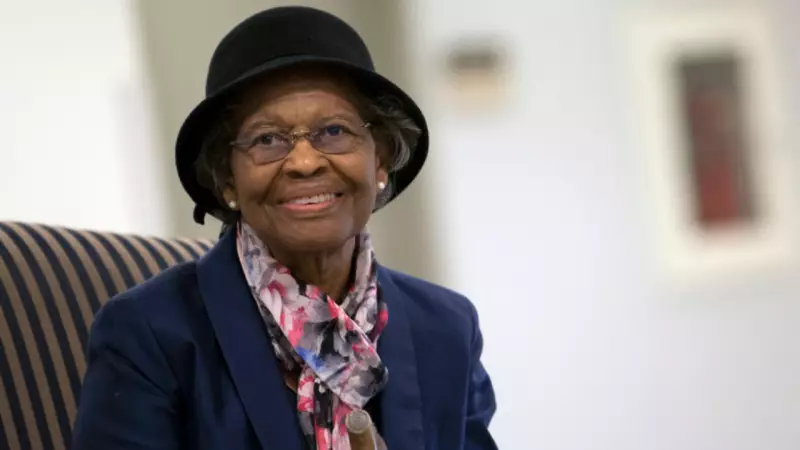
Dr Gladys West, GPS Pioneer and 'Hidden Figure' Mathematician, Dies at 95
The world of science and technology mourns the loss of Dr Gladys West, the pioneering American mathematician whose foundational work in satellite geodesy helped establish the remarkable accuracy of modern Global Positioning System (GPS) technology. Dr West passed away on January 17, 2026, at the age of 95, sparking an outpouring of tributes from scientists, engineers, and grateful users worldwide who recognize her profound impact on one of today's most ubiquitous technologies.
The 'Hidden Figure' Behind GPS Precision
For decades, Dr Gladys West remained a 'hidden figure' in the annals of scientific history. While her contributions were monumental, they stayed largely out of the public spotlight, known primarily within technical and academic circles. This changed in recent years as increased attention turned toward under-credited contributors, especially women and minorities, in science, technology, engineering, and mathematics (STEM) fields.
Her story is one of quiet dedication and exceptional intellect that fundamentally shaped how we navigate our world today.

The Mathematical Foundation of Modern Navigation
GPS technology operates through a constellation of satellites, but its legendary accuracy depends on far more than just signals and timing. The system requires precise mathematical modeling of the Earth's complex shape, gravitational forces, and geophysical characteristics—all factors that critically influence satellite orbits and positioning calculations.
Dr West's specialized research in geodesy—the science of measuring and understanding the Earth's geometric shape, orientation in space, and gravity field—provided essential improvements to how our planet is represented within satellite-based systems. Her meticulous work supported broader scientific advances that eventually transformed GPS from a theoretical concept into a dependable, real-world navigation tool used by billions.
A 42-Year Legacy at the US Navy Research Center
Dr West dedicated an impressive 42-year career to the United States Navy's research facility in Dahlgren, Virginia. There, she established herself as an expert in handling complex computations and sophisticated satellite data analysis. Her responsibilities involved:
- Processing enormous datasets collected from various satellite missions
- Developing and refining mathematical models that significantly enhanced measurement accuracy
- Contributing to research that became fundamental to the field of satellite geodesy
This research proved crucial in strengthening the reliability and precision of military and civilian navigation systems, creating ripple effects that would eventually reach everyday technology users globally.
Late-Life Achievements and Growing Recognition
Even after her retirement, Dr West demonstrated an extraordinary commitment to lifelong learning. In a remarkable academic achievement, she earned her PhD in Public Administration at approximately 70 years of age—a fact frequently highlighted in tributes celebrating her relentless intellectual curiosity and determination.
Following news of her passing, commemorations have emphasized both her technical impact on modern navigation and her role as a barrier-breaking figure in STEM. Social media platforms and professional communities have been flooded with messages acknowledging how her mathematical work touches countless lives daily, often without direct recognition.
Understanding Her True Legacy
It is important to clarify that Dr Gladys West was not the sole inventor of GPS, which emerged from large-scale collaboration across government, defense, and scientific institutions. However, her specific contributions in modeling the Earth with unprecedented precision supported critical improvements that made GPS both accurate and practical for widespread use.
Her legacy is felt continuously in the modern navigation tools embedded in smartphones, vehicle systems, aviation, maritime operations, and emergency services. Every time someone uses a mapping application or receives location-based services, they benefit from the mathematical foundations that Dr West helped solidify—even if they never learn her name.

Dr Gladys West's story transcends mere technological contribution; it represents the often-overlooked human element behind great innovations. Her journey from 'hidden figure' to recognized pioneer serves as both an inspiration and a reminder of the countless unsung experts whose work shapes our technological landscape.