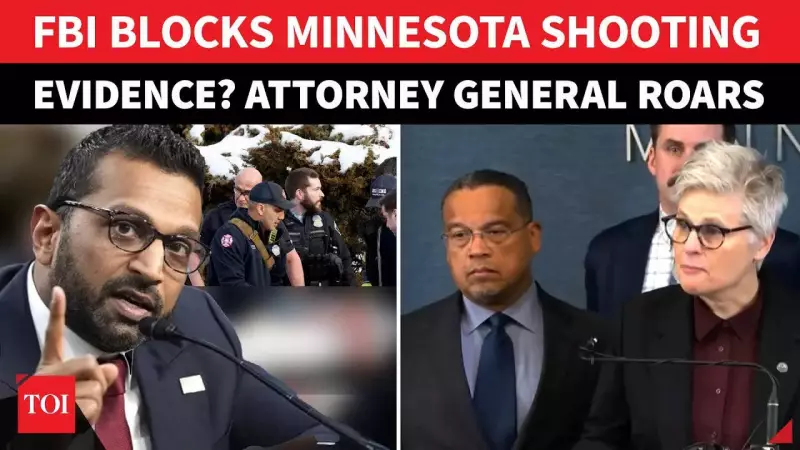
Minnesota's top legal official has launched a scathing attack on federal authorities, accusing them of obstructing a state-level investigation into a fatal shooting by immigration officers. Attorney General Keith Ellison publicly lambasted the FBI for what he termed a deliberate effort to undermine transparency in the probe related to the death of Renee Nicole Good in Minneapolis.
Attorney General's Public Rebuke
During a tense press conference, Attorney General Keith Ellison did not mince words. He blasted federal agencies for their handling of the controversial incident involving Immigration and Customs Enforcement (ICE) personnel. The core of his accusation centers on the FBI's decision to bar Minnesota's own Bureau of Criminal Apprehension (BCA) from accessing critical evidence related to the shooting that resulted in the death of Renee Nicole Good.
Ellison framed this action as a direct obstruction of justice at the state level. He emphasized that shutting out qualified state investigators not only hampers the search for truth but also erodes public trust in the entire process. His demand was clear and unequivocal: federal authorities must allow for a full and inclusive investigation where all relevant parties, including state bodies, have complete access to evidence.

The Mounting Pressure for Accountability
The Attorney General's forceful statements come amid growing public unrest and continued protests in Minneapolis. Community pressure for accountability and clarity around the circumstances of Good's death has been steadily increasing. Ellison's public intervention signals that the state government is aligning with these public demands, setting the stage for a potential jurisdictional clash with Washington.
By calling out the FBI specifically, Ellison has elevated the issue from a local law enforcement matter to a high-stakes conflict over investigative authority and transparency. His criticism suggests a belief that federal authorities are attempting to control the narrative and findings of the probe by limiting who can examine the facts.
A Call for Transparency and Next Steps
In his remarks, Ellison went beyond criticism to issue a direct call for action. He demanded immediate accountability from the federal agencies involved and insisted on a cooperative investigative framework. The standoff highlights the often-complex relationship between state and federal law enforcement, especially in cases involving federal officers and politically sensitive outcomes.
The situation remains fluid, with the Minnesota Bureau of Criminal Apprehension still officially locked out of key evidence as of January 10, 2026. Whether Ellison's public lambasting will force the FBI to change its stance and grant access is the critical question now. The outcome will significantly impact public perception of the investigation's fairness and the possibility of justice for Renee Nicole Good and her family.