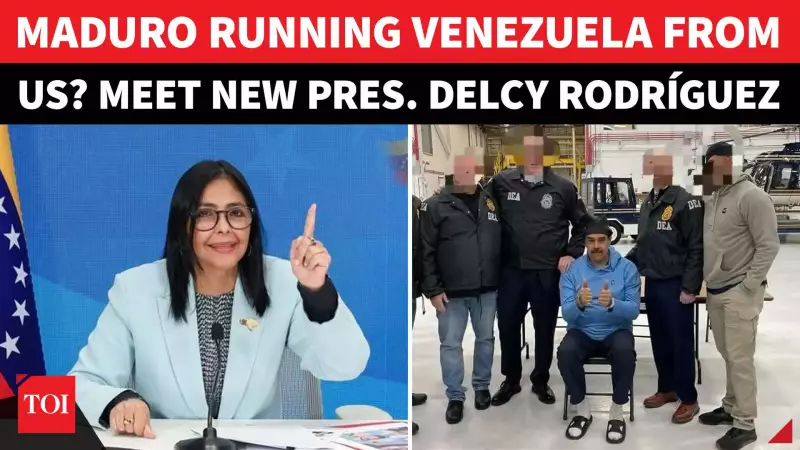
In a dramatic constitutional shift, Venezuela's political landscape has been fundamentally altered. The nation's Supreme Court has officially appointed Vice President Delcy Rodríguez as the Interim President of Venezuela. This decisive move follows the alleged capture of President Nicolás Maduro by United States military forces.
Constitutional Transition of Power
The judicial appointment was made under the specific provisions of Articles 233 and 234 of the Venezuelan constitution. This legal mechanism is triggered when the presidency becomes vacant, allowing the high court to designate an interim leader to ensure governmental continuity. The event, dated January 4, 2026, marks a sudden and unprecedented transition of power in Caracas.
For years, Delcy Rodríguez operated as a formidable power behind the scenes. She held critical roles as the country's oil chief and primary economic authority, effectively managing the state's most vital levers of power and finance. Her overnight ascension to the presidency solidifies her position as the most powerful individual in Venezuela, now commanding the office she long influenced from adjacent corridors of power.

The Operation That Precipitated the Change
The catalyst for this political earthquake was a bold military operation reportedly ordered by former US President Donald Trump. Codenamed 'Operation Absolute Resolve', the mission involved a significant deployment of force. Reports suggest approximately 150 American aircraft were part of the operation, which culminated in Maduro's capture within a stunning 30-minute window in Caracas.
Details emerging from US sources describe a fierce confrontation at one of Maduro's fortresses, involving steel doors, gunfire, and a failed attempt by the Venezuelan leader to flee. Subsequently, Maduro was reportedly flown out of the country by Delta Force operatives, eventually landing in the United States where he was seen handcuffed and escorted by FBI agents. The former president was reportedly jailed in New York, with Trump publicly hailing the mission as a "brilliant" success.
Global Repercussions and Future Uncertainty
This audacious move has sent shockwaves through international diplomacy. Major global powers China and Russia, key allies of the Maduro regime, have condemned the action, stating the US "crossed red lines" and hinting at potential retaliation. The future of Venezuela's vast oil reserves, a central point of geopolitical contention, is now in question. The new interim administration, alongside US strategic interests, will determine whether these resources are directed towards Western markets or traditional partners in Moscow and Beijing.
Meanwhile, the Venezuelan government, now under Rodríguez's interim command, has formally demanded "proof of life" for Maduro from US authorities. The nation watches as a once-behind-the-scenes operator steps into the global spotlight, tasked with navigating a profound national crisis and an intensely volatile international standoff.