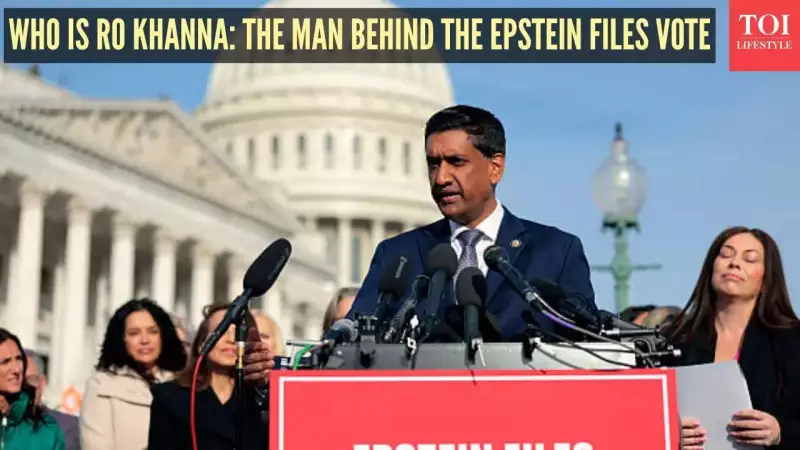
In a landmark decision that could reshape American political dynamics, the United States Congress has taken unprecedented action to force transparency in one of the most controversial cases in recent history. The unanimous vote marks a significant victory for government accountability and public right to information.
Historic Congressional Vote on Epstein Documents
On November 18, 2025, the U.S. Congress demonstrated rare bipartisan unity when both chambers voted overwhelmingly to compel the release of Justice Department files concerning the late convicted sex offender Jeffrey Epstein. The House of Representatives passed the resolution with an astonishing 427-1 vote, demonstrating near-total consensus across party lines.
The measure, which requires the disclosure of all unclassified records related to Epstein, quickly moved to the Senate where it received final approval. The legislation now awaits the final signature from President Trump's desk to become law. This development comes after years of mounting public pressure and speculation surrounding the Epstein case, which has remained one of the most trending topics in American politics.

Ro Khanna: The Emerging Political Force
Among the chorus of congressmen supporting the document release, Representative Ro Khanna has emerged as a particularly prominent voice. The Indian-American politician has positioned himself at the forefront of this historic movement, seeing Tuesday's legislative triumph as validation of his political strategy and leadership capabilities.
According to Khanna, this victory demonstrates his effectiveness as a potential party leader and even strengthens his credentials for consideration in the 2028 presidential election. In an exclusive interview with CNN, the congressman emphasized that the successful vote vindicates his approach of maintaining relationships with Republicans and his willingness to engage with virtually any political party to achieve results.
Who is Ro Khanna?
Rohit Khanna, the 45-year-old Indian-origin American politician and attorney, currently represents California's 17th District in the 117th Congress. First elected to Congress in 2016, he is now serving his third term representing the prestigious Silicon Valley region. His professional background is as impressive as his political career, having served as a Lecturer in the Department of Economics at Stanford University and Adjunct Professor at Santa Clara Law School.
Khanna is also an accomplished author with two published books to his credit: 'Entrepreneurial Nation: Why Manufacturing is Still Key to America's Future' and 'Dignity in a Digital Age'. His intellectual contributions have established him as a thought leader in economic and technological policy.
Personal Background and Financial Standing
Born in September 1976 in Philadelphia, Pennsylvania, Khanna comes from a family of Indian immigrants with roots in a Punjabi Hindu family. His father worked as a chemical engineer while his mother was a schoolteacher. His family history includes notable involvement in India's freedom struggle, with his maternal grandfather Amarnath Vidyalankar having worked alongside the legendary freedom fighter Lala Lajpat Rai.
On the personal front, Khanna is married to Ritu Khanna, also an Indian-American. The couple has two children and makes their home in Fremont, California. Educationally, Khanna is a distinguished graduate, having completed his schooling at Council Rock High School in 1994, earned a BA in economics from the University of Chicago, and received his law degree from Yale University.
Financially, Khanna has established considerable wealth, with San Jose Inside reporting a net worth of $27 million in 2018. This financial standing made him the fourth-richest Californian in Congress at that time.
Political Implications and Future Prospects
Khanna's ability to capture the spotlight on trending issues has rapidly transformed him into the token Democrat for media interviews. This visibility, which he believes will work to his advantage in future political endeavors, has been particularly amplified by his central role in the Epstein files release movement.

As the political landscape continues to evolve, Khanna's strategic positioning on this high-profile issue demonstrates his understanding of contemporary political dynamics. His current prominence in the Epstein document release spotlight not only enhances his national profile but also establishes him as a significant figure to watch in upcoming election cycles, potentially culminating in a 2028 presidential bid.