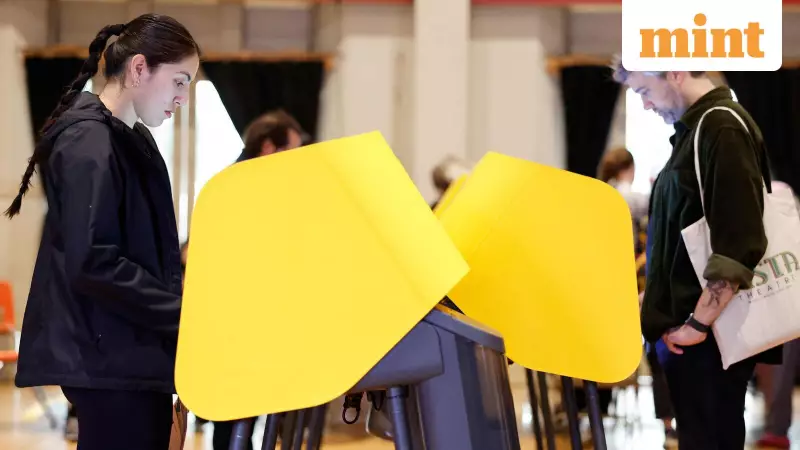
American voters are sending a clear message of discontent with their government's inability to address pressing national issues, as evidenced by recent electoral shifts and the longest federal shutdown in US history.
Electoral Backlash Signals Voter Impatience
Just twelve months after President Trump's sweeping victory across all seven key battleground states, voters have delivered a sharp rebuke to Republican leadership. Tuesday's elections saw significant Democratic gains as Americans expressed frustration with the government's failure to tackle affordability concerns and other major challenges.
The rapid political reversal highlights a narrowly divided nation that's increasingly quick to replace elected officials perceived as ineffective. The current federal shutdown has now extended into the longest such closure in American history, symbolizing for many citizens a government that has literally stopped functioning.

Historical Context of Political Division
Princeton University presidential historian Julian Zelizer noted the governing challenges in this era of intense political polarization. "It fuels an endless throw-the-bums-out electorate," he observed, pointing to the difficulty of achieving legislative consensus in the current environment.
The contrast with earlier administrations is stark. During Lyndon B. Johnson's presidency, massive legislative packages regularly passed through Congress when party control of Washington changed less frequently. This governing capability diminished as public trust eroded during the Vietnam War era and further declined amid the Watergate scandal and economic struggles of the 1970s.
According to Pew Research Center data, only about 20% of Americans now trust the federal government to do the right thing consistently. The era of landslide presidential victories has also passed—while Ronald Reagan won 49 states in 1984, Trump secured only 49.8% of the popular vote in his 2024 Electoral College victory.
Voter Sentiment and Electoral Consequences
Recent decades have seen frequent power shifts between parties, with control of the Senate, House, and White House changing hands four times in the past twenty years. This volatility reflects voter demands for more substantial changes from Washington leadership.
AP VoteCast surveys of over 120,000 voters revealed that approximately 30% of respondents wanted complete upheaval in how the country is governed during the 2024 election. More than half sought substantial changes, indicating widespread dissatisfaction with the status quo.
New Jersey served as a key testing ground for understanding voter sentiment ahead of next year's critical midterm elections. The state provided clearer insights than Virginia, which faced additional complications from Trump administration dismissals of federal workers and ongoing shutdown-related furloughs.
SSRS voter polls showed that 40% of New Jersey voters felt "angry" about the nation's direction, with another 26% expressing dissatisfaction. More than half—56%—disapproved of President Trump's job performance.
Shifting Political Coalitions
Tuesday's Democratic victories challenged Republican assertions that Trump had engineered a lasting realignment favoring the GOP. Both Black and Hispanic voters, traditionally Democratic constituencies, returned to supporting Democrats after the president had made gains among these groups in 2024.
The parties have also experienced a demographic flip in their core supporters. Democrats previously drew more support from voters without college degrees, while Republicans attracted college-educated constituents. However, non-college voters now show lower turnout rates except when Trump appears on the ballot.
Republican pollster Whit Ayres warned against ignoring the electoral signals, noting that "small changes in the margins mean large changes in control and large changes in public policy." He identified cost of living and economic conditions as primary voter concerns.

Democratic pollster Jeff Horwitt described the deep voter frustration stemming from feeling overlooked by the political establishment. "This anger leads to volatility and powerful, seemingly contradictory messages being sent from one election to the next," he explained. "The throughline is the view that our leaders are out of step with the voters."
Jonathan Cowan of Third Way emphasized that "whoever owns the center in American politics owns the country," pointing to swing voters' disgust with both far-left and far-right ideologies.
As Zelizer concluded, the pattern of seesaw elections will likely continue until one party manages to "build a broader coalition" that proves more enduring—the essential requirement for escaping the current cycle of political volatility.