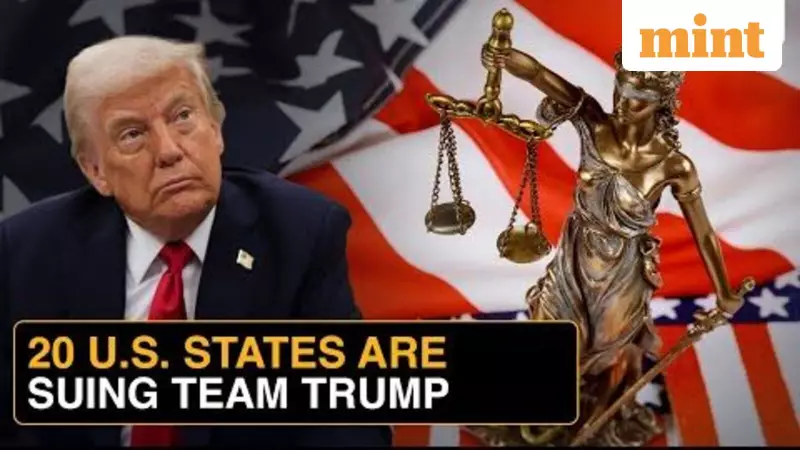
A major legal and political battle has erupted in the United States, directly impacting the future of skilled foreign workers, particularly from India. A coalition of twenty American states has initiated a lawsuit against the administration of former President Donald Trump over a controversial and dramatic increase in H-1B visa fees.
The Core of the Legal Challenge
The lawsuit, filed in a federal court, targets a new policy that raises the fee for an H-1B visa application to a staggering $100,000. The legal action is being spearheaded by the states of California, New York, and Massachusetts. The plaintiffs argue that the fee hike is not only illegal but also destructive to their economies and essential public services.
They contend that the move would severely cripple hospitals, universities, and technology companies that are heavily reliant on skilled foreign professionals. These sectors routinely hire engineers, doctors, nurses, and researchers through the H-1B program to fill critical talent shortages.

White House Defense and Industry Backlash
The White House, defending the policy, has stated that the primary goal is to protect American workers from wage suppression and potential abuse of the visa system. Officials argue that the exorbitant fee will deter companies from hiring foreign talent over domestic candidates and generate revenue.
However, this rationale is being fiercely contested. The lawsuit claims the policy oversteps administrative authority and was enacted without due process. For the Indian IT sector, which has been the dominant user of the H-1B visa for decades, this development represents a massive blow. It threatens to drastically increase operational costs and limit the ability of both Indian IT firms and US-based companies to hire top tech talent from India.
What Happens Next?
The central question now rests with the judiciary. Will the courts block this game-changing policy? Legal experts anticipate a protracted battle. The outcome will hinge on interpretations of immigration law and executive power. The case, with an update timestamp of 16 December 2025, 09:53 pm IST, is being closely watched by global corporations, the Indian diaspora, and governments worldwide.
The immediate consequences are already causing anxiety:
- US businesses face uncertainty in long-term project staffing.
- Indian IT majors may need to accelerate local hiring in the US or shift strategies.
- Other countries with skilled immigration programs could become more attractive destinations.
This legal storm underscores the ongoing tension in US immigration policy between protectionism and global competitiveness. The final court decision will set a significant precedent for how America manages its demand for high-skilled global talent in the future.