Every clean energy source has a limitation. Solar power stops when the sun sets. Wind energy ceases when the air is still. Even hydropower depends on seasonal water flow. What the global grid truly lacks is a clean energy source that operates through the night and during storms without relying on weather conditions. Since August 2025, a facility within a desalination plant on Japan's southern coast has been generating electricity continuously from the difference between fresh water and seawater. This is Asia's first osmotic power plant and only the second of its kind worldwide, producing power without burning any fuel.
The Science Behind Japan's 24/7 Power Plant
The principle behind the plant is similar to how a tree draws water through its roots. When fresh water and saltwater are separated by a semi-permeable membrane, fresh water naturally moves toward the saltwater to dilute it, driven by the need to balance concentration differences. Inside a sealed pressure chamber, this movement increases the volume on the salty side, building pressure. That pressure is then used to drive a turbine, generating electricity solely from the difference between two types of water.
This process is called pressure-retarded osmosis (PRO). A 2024 study in Chemical Engineering Science highlighted novel membrane modifications that advance PRO for sustainable power generation from salinity gradients, a key challenge that has hindered commercial scaling for decades. In a standard seawater-to-freshwater setup, a pressure difference of about 26 bar is required, equivalent to the pressure at the bottom of a 270-meter water column. The energy generated must cover the costs of pumping both water streams and pushing water through the membranes, with net output being what remains after these losses.

The Fukuoka Plant: Efficient Use of Waste Streams
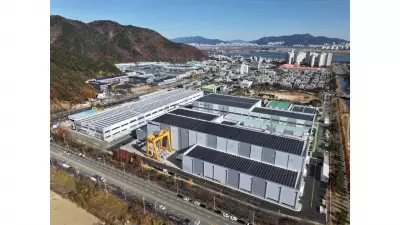
The Fukuoka plant, located at the Uminonakamichi Nata Seawater Desalination Centre, began operation on August 5, 2025. Its efficiency stems from using concentrated brine—the saline waste from desalination—instead of ordinary seawater on the salty side. On the other side, treated wastewater from a nearby sewage facility is used. These two waste streams, already produced by existing infrastructure, flow past each other across a membrane, generating power. The Japanese government notes that using hypersaline brine widens the salinity gradient, extracting more energy than regular seawater would allow.
Output and Reliability
The plant's projected annual output is about 880,000 kilowatt-hours, enough to cover a portion of the desalination plant's electricity needs and power between 220 and 300 average Japanese households. While modest by grid standards, the key advantage is reliability. The plant operates at a utilization rate of roughly 90%, running consistently regardless of cloud cover, wind speed, or time of day. A techno-economic analysis in Frontiers in Energy Research confirmed that integrating PRO with desalination plants is commercially viable because the brine waste stream is produced at no additional cost. The power generated feeds back into producing drinking water for Fukuoka, reducing the desalination process's overall cost.
Kenji Hirokawa, head of the Seawater Desalination Centre, describes the plant as a modest first step rather than a final solution. This realistic framing sets appropriate expectations for a technology still proving itself at scale.
Norway's Earlier Attempt
Japan's facility is not the first osmotic power plant. The concept was first proposed by a US researcher in 1976 in the Journal of Membrane Science, but serious hardware took decades to appear. Norwegian utility Statkraft opened the world's first PRO prototype at Tofte on the Oslo Fjord in November 2009, designed for 10 kilowatts but generating only 2 to 4 kilowatts in practice. While the concept worked, the economics did not. By January 2014, Statkraft shut down the project, citing insufficient membrane efficiency for commercial competition.
The core issue was power density. Research indicates that around 5 watts per square meter of membrane is the threshold for financial viability, as cited in ACS ES&T Engineering. Statkraft's plant operated at 1 to 3 watts per square meter. This gap between theoretical promise and membrane performance stalled the technology for a decade.

Japan's approach uses the brine-plus-wastewater combination to widen the salinity differential, extracting meaningful output from available membrane technology without waiting for a breakthrough. This pragmatic engineering decision leverages freely available inputs at the site, bypassing the need for a membrane revolution that has been elusive for fifty years.