

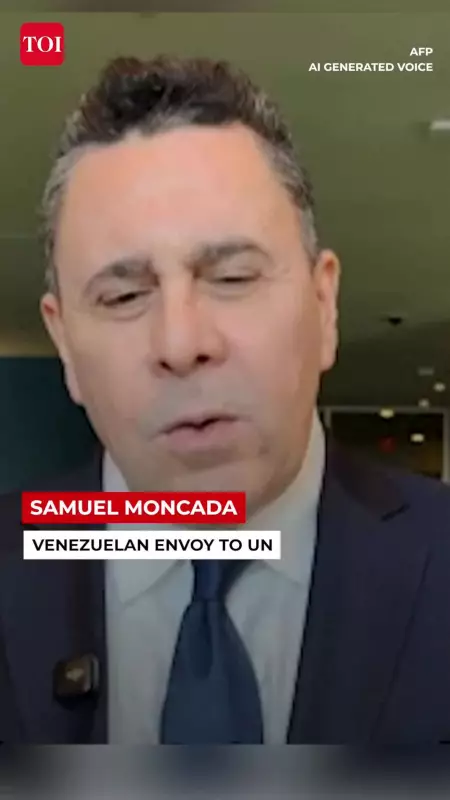
Venezuela has launched a fierce diplomatic offensive at the United Nations, accusing the United States of committing an act of "state-sponsored piracy" by seizing an oil tanker. The incident, which Caracas labels a brazen theft, has sharply escalated tensions between the two nations.
Venezuela's Scorching Accusation at the UN
In a dramatic move on December 17, 2025, Venezuela's ambassador to the UN, Samuel Moncada, presented a formal complaint before the Security Council. The core allegation is that the United States illegally confiscated a Venezuelan oil tanker under the pretext of conducting an anti-drug operation in Caribbean waters.
Ambassador Moncada, in a strongly-worded letter, denounced the American action as an act of open aggression. He argued that this move was not about law enforcement but was a deliberate strategy to increase economic and political pressure on the Venezuelan government. The ambassador urged the 15-member Council to publicly denounce what he described as a flagrant violation of international law.

A Violation of Sovereignty and Law
The Venezuelan representation framed the tanker's seizure as a direct assault on national sovereignty. Moncada warned that such "lawless actions" not only trample on the sovereign rights of nations but also make a mockery of the established frameworks of international law. The appeal to the UN underscores Caracas's attempt to internationalize the dispute and seek multilateral legitimacy for its position against Washington.
While the specific name of the tanker and the precise location of the seizure were not detailed in the initial report, the timing and public nature of the accusation indicate a significant escalation. The US has historically conducted anti-narcotics patrols in the Caribbean, often intercepting vessels suspected of drug trafficking. However, Venezuela categorically rejects this justification in the current case.
Broader Context of US-Venezuela Relations
This incident does not occur in a vacuum. Relations between the United States and Venezuela have been severely strained for years, marked by:
- Stringent US sanctions on Venezuela's crucial oil industry.
- Recognition disputes over Venezuela's political leadership.
- Previous confrontations involving Venezuelan assets and shipping.
The tanker seizure is viewed by Caracas as the latest step in a campaign of "maximum pressure" from Washington. By taking the matter to the UN Security Council, Venezuela is seeking to portray the US as a rogue actor that disregards global norms, hoping to rally diplomatic support from other nations critical of unilateral American actions.
What Happens Next?
The ball is now in the court of the United Nations Security Council. It remains to be seen if other member states will back Venezuela's call for a formal condemnation of the United States. Given the complex geopolitical dynamics and the veto power held by permanent members like the US, a decisive action against Washington is unlikely. However, the move successfully spotlights the ongoing friction and could lead to heated debates within the international body.
The situation highlights the continuing volatility in US-Venezuela relations and raises serious questions about the interpretation and application of international law in maritime disputes and sanctions enforcement. The world will be watching the UNSC's response closely.






