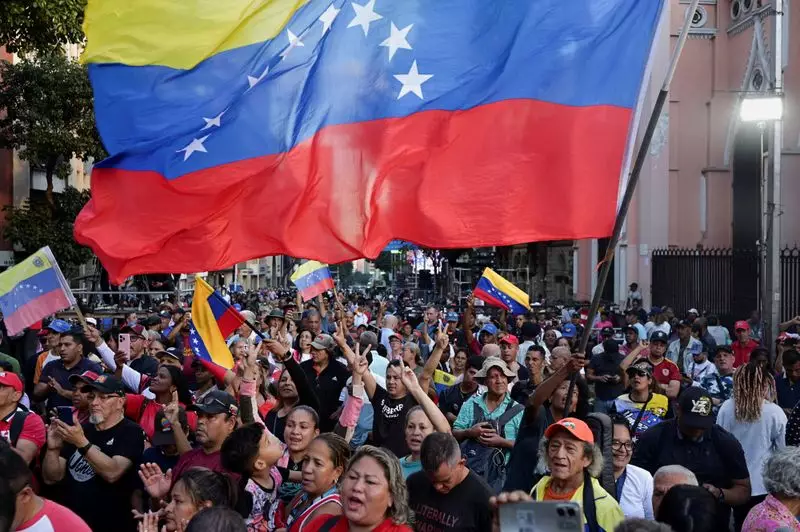
The United Nations Security Council became the stage for a diplomatic showdown on Thursday, as the United States and Russia traded sharp words over a foiled plot to attack Venezuela's presidential palace and kidnap President Nicolas Maduro. The emergency meeting, requested by Moscow, highlighted the deep international divisions surrounding the South American nation's political crisis.
A Condemned Plot and Pointed Accusations
The session was convened in the wake of Venezuelan authorities announcing they had thwarted a serious conspiracy. According to officials in Caracas, the plan involved armed assaults on the Miraflores presidential palace and other key institutions, culminating in the abduction of President Maduro. Venezuela's Foreign Minister, Yvan Gil Pinto, addressed the Council, asserting that the foiled attack proves the existence of "terrorist groups" actively seeking to destabilize his country. He pointed fingers at "ultra-right-wing factions" with connections to foreign powers, though he did not name specific nations during his public remarks.
The Russian delegation seized the opportunity to launch a direct critique of the United States. Deputy Ambassador to the UN, Dmitry Polyanskiy, accused Washington of employing a "dirty toolbox" of tactics against governments it opposes. Polyanskiy explicitly linked the alleged plot to the US, stating, "We have no doubt that the direct organizers and sponsors of this terrorist act are the United States." He argued that such methods, including support for opposition figures, have become a standard part of American foreign policy to force political change in sovereign states.

US Rebuttal and Calls for Democratic Transition
The American representative swiftly and firmly rejected the Russian allegations. Robert Wood, the US alternate representative to the UN, dismissed the claims as baseless and a distraction from the real issues facing Venezuela. "The United States had no involvement in this incident," Wood stated unequivocally. "We categorically reject any allegations implying the contrary." He framed the discussion as a Russian attempt to deflect attention from what he described as the Maduro government's failures.
Instead, the US diplomat refocused the conversation on Venezuela's internal political situation. Wood emphasized the need for a return to democratic governance, urging Caracas to implement the electoral roadmap agreed upon with the opposition in Barbados last year. He called for the release of all political prisoners and the creation of conditions for free and fair presidential elections, which are currently scheduled for later this year.
International Reactions and the UN's Stance
The council debate revealed a familiar geopolitical split. China's representative echoed Russia's concerns about foreign interference, warning against actions that could escalate tensions in Venezuela. Other nations, while condemning the violent plot in principle, urged all parties to seek peaceful and constitutional solutions to the country's prolonged crisis.
The United Nations Secretariat maintained a position of neutrality focused on humanitarian and political processes. A UN spokesperson, speaking on behalf of Secretary-General Antonio Guterres, reiterated the organization's condemnation of any violent actions aimed at destabilizing Venezuela. The spokesperson reaffirmed the UN's support for peaceful dialogue and a negotiated settlement facilitated by Venezuelans themselves. The organization continues to be engaged in humanitarian efforts within the country and supports the ongoing political talks.
The emergency meeting concluded without any collective statement or resolution, a common outcome in the deeply divided Security Council when it comes to Venezuela. The verbal clash between Washington and Moscow, however, served as a stark reminder of how Venezuela remains a flashpoint for broader international rivalries, with its population caught in the middle of a protracted political and economic emergency.