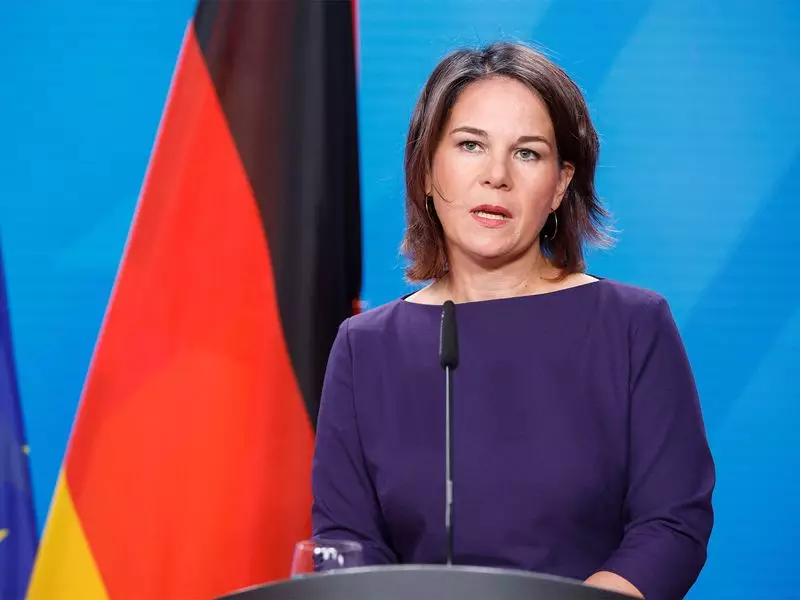
German Foreign Minister Annalena Baerbock delivered a powerful message at the United Nations, emphasizing the fundamental importance of the UN Charter in addressing global crises, specifically referencing the ongoing political situation in Venezuela. Her statement came during a high-level meeting of the UN General Assembly focused on the rule of law.
Upholding the Pillars of International Order
Baerbock, speaking in her capacity as the President of the 78th Session of the UN General Assembly, left no room for ambiguity. She declared that the UN Charter is not an optional guideline but the foundational bedrock of the international community. Her remarks were a clear call for all member states to adhere strictly to the principles enshrined in the charter, particularly those concerning sovereignty, territorial integrity, and the peaceful resolution of disputes.
The German minister directly linked these universal principles to the current crisis in Venezuela. She stressed that the upcoming presidential elections in Venezuela, scheduled for July 28, 2024, must be conducted in a manner that is fully compliant with international democratic standards. Baerbock underscored that the will of the Venezuelan people must be the sole determinant of the country's political future, free from external coercion or internal manipulation.

A Direct Appeal for Democratic Integrity
In her address, Baerbock made a pointed appeal for concrete actions to ensure a fair electoral process. She called upon the Venezuelan authorities to implement the necessary conditions that would guarantee a free and fair vote. This includes allowing all eligible candidates to participate without obstruction and ensuring that international observers can monitor the elections without restrictions.
Her intervention highlights the growing international concern over the political trajectory in Venezuela, where previous elections have been marred by allegations of irregularities and the disqualification of opposition figures. By invoking the UN Charter, Baerbock positioned the issue not as a matter of political preference but as a test of the international community's commitment to its own stated rules.
The Broader Implications for Global Governance
The German Foreign Minister's statement carries significant weight beyond the immediate context of Venezuela. It serves as a reminder at a time when the rules-based international order faces numerous challenges from conflicts and geopolitical tensions worldwide. By stating that the charter is "not optional," she implicitly criticized any nation that selectively applies or outright violates international law for its own benefit.
The principle of the sovereign equality of states, a core tenet of the UN Charter, was central to her argument. Baerbock argued that true sovereignty is protected, not undermined, by respecting the charter's framework. Her message was clear: lasting peace and stability, whether in South America or any other region, are unattainable if the foundational document of the UN is treated as a mere suggestion.
The high-level meeting on the rule of law at the UN General Assembly provided the perfect platform for this reaffirmation. It gathered diplomats and leaders to discuss the practical implementation of international legal frameworks. Baerbock's forceful stance on Venezuela sets a precedent, indicating that the conduct of national elections is a matter of legitimate international concern when it pertains to the fundamental principles of the UN.
As the world watches the developments in Venezuela leading up to the July elections, Baerbock's words will resonate as a benchmark. They frame the crisis not just as an internal political struggle but as a litmus test for the integrity and relevance of the United Nations system itself. The international community's response, guided by the non-optional nature of its charter, will be closely scrutinized in the coming months.