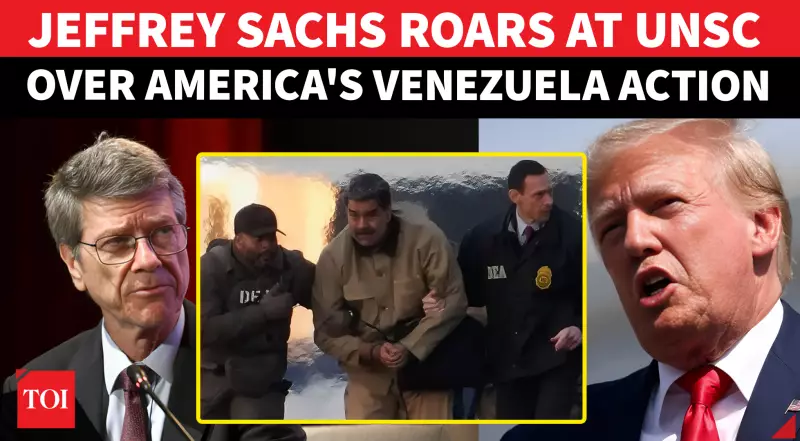
In a dramatic and tense session at the United Nations Security Council, celebrated economist Jeffrey Sachs delivered a scathing critique of the United States. He accused Washington of illegally intervening in Venezuela's affairs, forcibly removing President Nicolás Maduro from power, and capturing him along with his wife. The incident, which unfolded on January 6, 2026, left diplomats in stunned silence as Sachs demanded an immediate American exit from the South American nation and the broader region.
A Blistering Condemnation of US Foreign Policy
Jeffrey Sachs, a prominent figure in global development economics, did not mince words during his address. He condemned what he described as America's long and troubling history of orchestrating regime-change operations in sovereign countries. Sachs argued that such foreign military and political interference serves only to deepen instability and violate the core principles of international law. His central message was a direct and forceful command: "Americans must get out." He warned that these actions are pushing the world closer to chaos, undermining the very order the UN is meant to uphold.
The Context: Maduro's Capture and Aftermath
Sachs's fiery speech came in the wake of the reported capture of Venezuelan President Nicolás Maduro and his wife, Cilia Flores. Following the event, Maduro broke his silence, reportedly describing himself as a "Prisoner of War." In their first court hearing, images of his wife appearing bruised circulated widely, adding to the controversy. The operation has triggered significant political fallout within the United States as well, with reports of Democrats demanding impeachment proceedings against former President Donald Trump and divisions within the MAGA movement. Meanwhile, global reactions have been sharp, with China's Xi Jinping issuing warnings and Maduro's allies vowing resistance.

Broader Implications and Global Reactions
The confrontation at the UN highlights a significant geopolitical rift. Sachs's intervention frames the Venezuela situation not as an isolated incident but as part of a dangerous pattern of US hegemony. His arguments resonate with long-standing criticisms from other nations about Washington acting as a "world cop." The event has also exposed the high stakes involved, including China's substantial financial investments in Venezuela, estimated in the billions. The warning from Sachs underscores a growing fear that such interventions set a perilous precedent, potentially encouraging further unilateral actions in other conflict zones like Iran, thereby escalating global tensions.
The UNSC session, marked by Sachs's bold accusations, has reignited debates on sovereignty, international law, and the limits of superpower influence. It remains a pivotal moment that could shape diplomatic responses to future crises.