

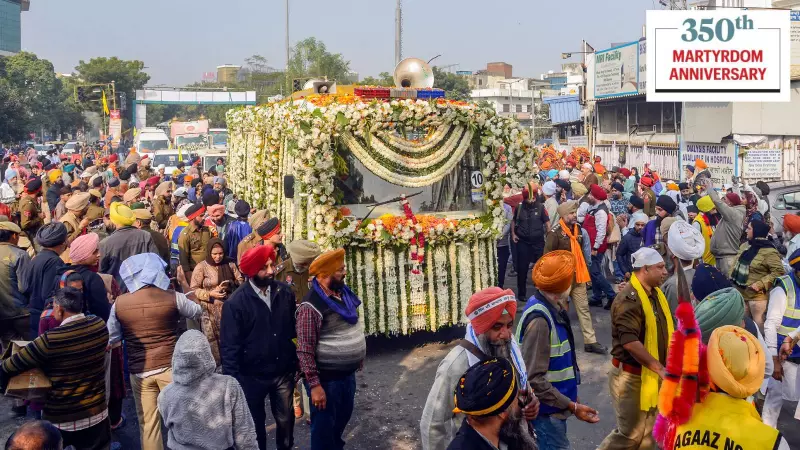
In a powerful appeal that bridges historical sacrifice with contemporary human rights advocacy, Sikh scholar and writer Gurcharanjit Singh Lamba has called for dedicating this year's Human Rights Day to Guru Tegh Bahadur, the ninth Sikh guru. The proposal comes during the 350th anniversary year of the guru's martyrdom, creating a significant opportunity to honor one of history's most profound acts of religious freedom defense.
The Historical Significance of Guru Tegh Bahadur's Sacrifice
Guru Tegh Bahadur laid down his life in 1675 at Chandni Chowk in Delhi, not for his own community but to protect the religious freedom of Kashmiri Pandits who faced forced conversions under Mughal emperor Aurangzeb. This extraordinary act earned him the title Hind Di Chaadar (Shield of India), representing a unique moment in world history where a spiritual leader sacrificed his life for another religious community's right to practice their faith.
US-based scholar Gurcharanjit Singh Lamba has formally written to the Shiromani Gurdwara Parbandhak Committee (SGPC) and other organizations, urging them to request the United Nations to dedicate Human Rights Day, observed annually on December 10, to Guru Tegh Bahadur in 2025. Lamba emphasizes that the Government of India should take this proposal to the UN, highlighting that the earliest and greatest victory for human rights occurred in 1675 in Delhi.

Alignment with Universal Declaration of Human Rights
The connection between Guru Tegh Bahadur's sacrifice and modern human rights principles is remarkably precise. Lamba explains that the guru's message of fear none, frighten none embodies the essence of universal human rights that would later be codified centuries after his death.
Exactly 273 years after Guru Tegh Bahadur's martyrdom, on December 10, 1948, the United Nations adopted the Universal Declaration of Human Rights (UDHR), signed by 48 countries including India. Lamba notes that Articles 1 and 18 of the UDHR particularly resonate with the principles the guru died defending.
Article 1 declares that all human beings are born free and equal in dignity and rights, while Article 18 establishes everyone's right to freedom of thought, conscience, and religion - including the freedom to change religion or belief and to manifest it in practice. These principles directly echo Guru Tegh Bahadur's sacrifice for the religious rights of Kashmiri Pandits.
Contemporary Relevance and Global Implications
Despite the passage of 350 years since Guru Tegh Bahadur's martyrdom, the issues he confronted remain alarmingly relevant in today's world. Rising intolerance, religious persecution, identity-driven conflicts, and forced conformity continue to challenge societies globally, making the guru's teachings and sacrifice profoundly meaningful for contemporary human rights discourse.
Lamba points out that in practical terms, the world has failed to ensure adequate religious freedom and human rights protection. Annual reports continue to document human rights violations worldwide, including in India, often met with governmental dismissals claiming insufficient understanding of local contexts. This persistent gap between principle and practice makes Guru Tegh Bahadur's martyrdom even more significant as a timeless example of moral courage.
The dedication of Human Rights Day 2025 to Guru Tegh Bahadur would serve multiple important purposes. It would honor what Lamba describes as the world's most profound act of sacrifice for another religion's freedom, highlight India's rich history of defending human dignity, reaffirm constitutional values of equality and justice, strengthen intercultural dialogue, and educate younger generations about universal moral courage.
As the world observes the 350th martyrdom anniversary of Guru Tegh Bahadur, this proposal represents a unique opportunity to bridge historical sacrifice with contemporary human rights advocacy, reminding global citizens that the struggle for religious freedom and human dignity has deep roots in South Asian history.






