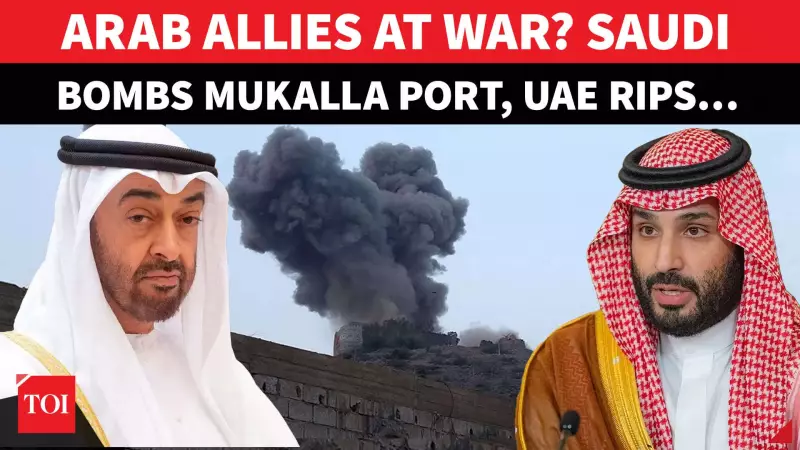
In a dramatic escalation that exposes a rare public fissure within the Gulf alliance, Saudi Arabia has launched airstrikes on the port of Mukalla in Yemen. The move, which occurred on December 31, 2025, prompted Yemen's government to declare a state of emergency and abruptly cancel its security agreement with Abu Dhabi.
Ultimatum and Airstrikes Mark Sharp Escalation
The Saudi-led military action was accompanied by a stern diplomatic move. Riyadh has issued a 24-hour ultimatum, demanding that forces from the United Arab Emirates (UAE) withdraw completely from Yemeni territory. This direct demand from one coalition partner to another highlights the deepening strategic divide over the future of Yemen.
The airstrikes targeting the crucial port city of Mukalla represent a significant intensification of Saudi Arabia's military campaign. The port is a key economic and logistical hub, and its bombardment signals a major shift in the conflict's dynamics.

Yemen's Response and the Coalition Rift
In response to the Saudi offensive, the Yemeni government took immediate and decisive steps. The declaration of a state of emergency grants authorities broader powers, while the cancellation of the security pact with the UAE severs a key pillar of the previous coalition framework. This action directly challenges Abu Dhabi's influence in southern Yemen, where it has backed separatist groups.
This public disagreement between Saudi Arabia and the UAE lays bare the underlying tensions that have simmered within the Gulf coalition for some time. The advancement of UAE-backed separatists in southern Yemen appears to be a central point of contention, with Riyadh now taking direct action to counter that influence.
Regional Implications and Fears of Wider Conflict
The sudden flare-up has sent shockwaves through the region, dramatically raising fears of a wider power struggle spilling over into the critical Red Sea zone. This vital maritime corridor is essential for global trade and energy shipments, and instability there carries international consequences.
The situation creates a complex multi-front scenario, where the war against Houthi rebels is now compounded by open discord between the leading Arab powers that were supposed to be allies. The regional tensions are surging, and the next steps taken by the UAE in response to the ultimatum will be closely watched by global observers.
This development marks one of the most serious public ruptures in the Gulf coalition since the Yemen conflict began, potentially reshaping alliances and strategies in a conflict that has already caused a profound humanitarian crisis.