

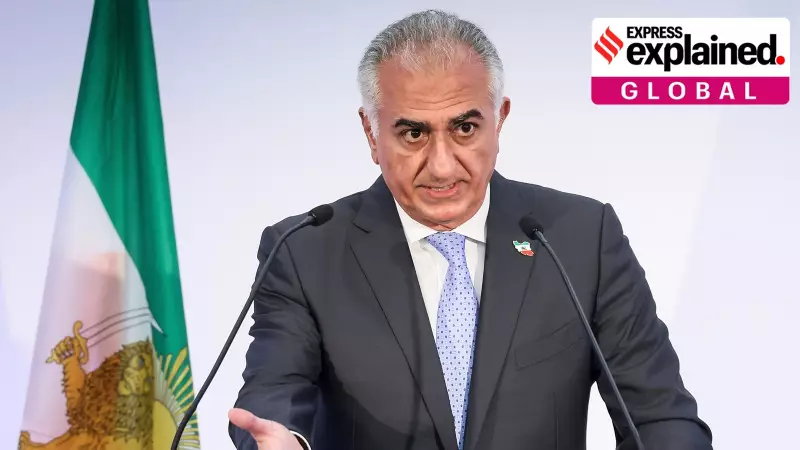
Reza Pahlavi, the exiled son of Iran's last monarch, has seized upon a new wave of domestic unrest to amplify his calls for the overthrow of the Islamic Republic. As protests fueled by severe inflation and economic hardship erupted across Iran in late December, resulting in at least 42 deaths by January 9, 2026, the 65-year-old heir has positioned himself as a focal point for opposition.
From Exile to Opposition Figurehead
In a series of high-profile media appearances and a pointed opinion piece for The Washington Post, Pahlavi has projected himself as a unifying force. He acknowledged that protesters' chants include his name alongside demands for freedom, interpreting this not as a personal power grab but as a "profound responsibility." His father, Shah Mohammad Reza Pahlavi, was deposed in the 1979 Islamic Revolution, forcing the family into exile where Reza has spent decades campaigning against what he terms a "repressive" and "tyrannical" government.
His activism has grown increasingly bold. Following a joint US-Israeli military strike on Iranian nuclear facilities in June 2025, Pahlavi told Politico that "the odds are very good" for the regime to fall by year's end. His strategy involves bridging Iran's fragmented opposition, bringing together monarchists, republicans, secularists, and religious groups around principles of territorial integrity, individual liberty, and the separation of church and state.

The Pahlavi Dynasty's Complex Legacy
To understand Reza Pahlavi's appeal, one must look back at the dynasty he represents. His grandfather, Reza Shah Pahlavi, founded the modern Pahlavi rule after a 1925 coup, ascending to power as Iran grappled with foreign domination by Russia and Britain. He promoted a narrative of resurrecting Iran's 2,500-year-old imperial glory, though his reign ended with forced abdication in 1941 after an Allied invasion.
The subsequent rise of Prime Minister Mohammed Mossadegh marked a pivotal turn. A champion of Iranian sovereignty, Mossadegh's move to nationalize the country's oil reserves in 1951 challenged Western control, famously held by the Anglo-Iranian Oil Company (now BP). This act triggered a US and UK-backed coup in 1953, which ousted Mossadegh and reinstated Mohammad Reza Pahlavi to power.
The Shah's rule was a paradox of modernization and brutal authoritarianism. While he pushed social and economic reforms, his secret police, SAVAK, became synonymous with the arrest and torture of dissidents. This repression, as historian Stephen Kinzer notes, pushed opposition into mosques, giving the eventual 1979 revolution its fundamentalist character. The Shah fled Iran that year, and a referendum established the Islamic Republic under Ayatollah Khomeini.
A Modern Shah's Diplomatic Gambits and Challenges
Reza Pahlavi's political maneuvering extends beyond rhetoric. A highly symbolic and controversial move was his 2023 visit to Israel, where he met Prime Minister Benjamin Netanyahu. Analysts like Professor Lior Sternfeld suggest this was less for an Iranian audience and more a signal to Washington, showcasing his potential to instantly resolve the Iran-Israel conflict. Pahlavi even offered that a future Iran under him would welcome Israeli expertise to solve its water crisis.
In a recent Wall Street Journal interview, he carefully navigated the topic of foreign intervention, stating it was not "necessary" in Iran while praising the Trump administration's stance. "I believe [Marco Rubio] is perhaps the first secretary of state ever since the Iranian revolution who truly gets it," he remarked, aligning himself with perceived hardline US support.
Despite these efforts, significant hurdles remain. The Iranian regime has demonstrated formidable endurance through its institutional power. Furthermore, the opposition, both inside and outside Iran, remains deeply divided, complicating Pahlavi's unifying mission. The 2022 protests provided a similar platform that ultimately did not translate into regime change, underscoring the gap between street anger and organized political overthrow.

As economic pain continues to simmer in Iran, Reza Pahlavi's voice from exile grows louder, attempting to channel popular discontent into a coherent challenge against theocratic rule. Whether he can transform his lineage from a contested historical symbol into a viable political future remains one of the most intriguing questions in Middle Eastern politics.





