

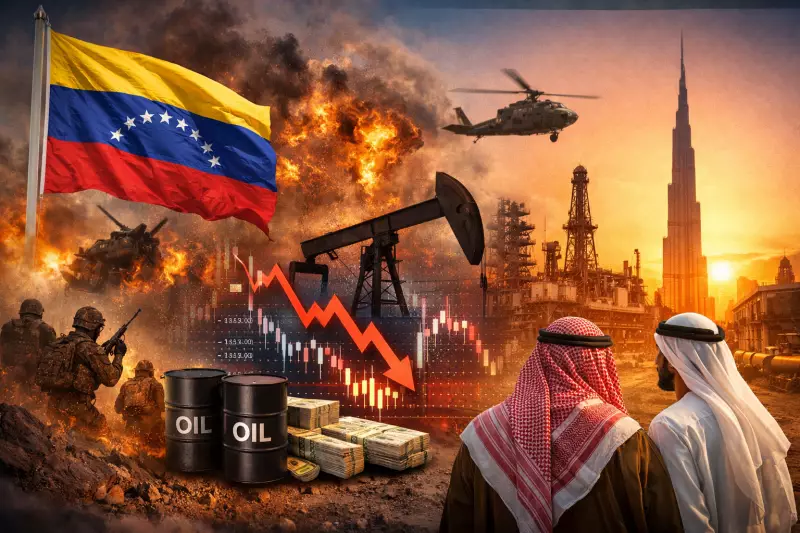
The dramatic capture of Venezuelan President Nicolás Maduro in January 2026, following a US military operation, sent shockwaves through global diplomacy. However, the reaction in the world's crucial energy markets, particularly in the oil-dependent Middle East, has been surprisingly measured. Instead of the feared price spikes, analysts point to a complex picture of oversupply and strategic reserves that is keeping a lid on volatility.
Limited Price Shock Despite Geopolitical Upheaval
Despite Venezuela holding the world's largest proven oil reserves, its current production tells a different story. Output stands at a modest 900,000 to 1.1 million barrels per day, a mere 1% of global supply. This steep decline from historic peaks is a result of years of underinvestment and international sanctions.
Giovanni Staunovo, a strategist at Swiss bank UBS, explained to The National that because Venezuela is no longer a major exporter, "a US attack is unlikely to trigger a material supply crisis." The immediate market response has been characterized as a slight uptick in the "Venezuela risk premium" rather than panic over physical shortages, a view echoed by Vandana Hari of Vanda Insights.

Global Oil Glut Cushions the Blow
A primary reason for the restrained market reaction lies in the broader supply dynamics of 2025-2026. The International Energy Agency (IEA) had already forecast the oil market to be in a surplus of several million barrels per day in 2026. This oversupply, driven by strong production from OPEC+, the United States, and other non-OPEC nations, has created a buffer against geopolitical shocks.
This context is critical for Middle Eastern producers like Saudi Arabia, the UAE, and Kuwait. Their collective output far exceeds Venezuela's current contribution, and their coordination through the OPEC+ alliance has been instrumental in managing market stability. An early January 2026 OPEC+ meeting reaffirmed steady output levels, prioritizing calm amidst political uncertainty.
The Nuance of Heavy Crude and Long-Term Uncertainties
While the overall price impact is muted, the specific quality of Venezuelan crude—heavy and sour—poses a nuanced challenge. This grade is a key feedstock for refineries, especially on the US Gulf Coast, and is not easily replaced by lighter oils. This creates subtle pressures in specific market segments, where Middle Eastern heavy crudes from Saudi Arabia, Iraq, and the UAE are direct competitors.
Looking ahead, the long-term revival of Venezuela's oil industry remains a major question. Analysts cited by the Associated Press suggest that rebuilding would require decades and tens of billions in investment, even under stable political conditions. For the Middle East, this means any future shift in competition from a resurgent Venezuela is a gradual, multi-year prospect, contingent on political stability and foreign investment.
What Middle Eastern Markets Must Monitor Next
Gulf investors and policymakers are advised to keep a close watch on several key developments:
- Changes to sanctions policy that could allow Venezuelan crude back into major export markets.
- OPEC+ coordination and any adjustments to production in response to evolving risk premiums.
- Shifts in heavy crude demand, particularly from US and Chinese refiners.
- Global inventory levels and demand forecasts, which remain the core price drivers beyond short-term events.
In conclusion, experts from UBS, Vanda Insights, Rystad Energy, and the IEA agree that the Venezuela event's short-term impact on oil prices is limited due to existing oversupply and Venezuela's small production share. However, it has undeniably heightened the geopolitical risk premium and introduced longer-term questions about the future re-entry of Venezuelan oil into the global market—a development that will be closely tracked by Middle Eastern producers and consumers throughout 2026 and beyond.






