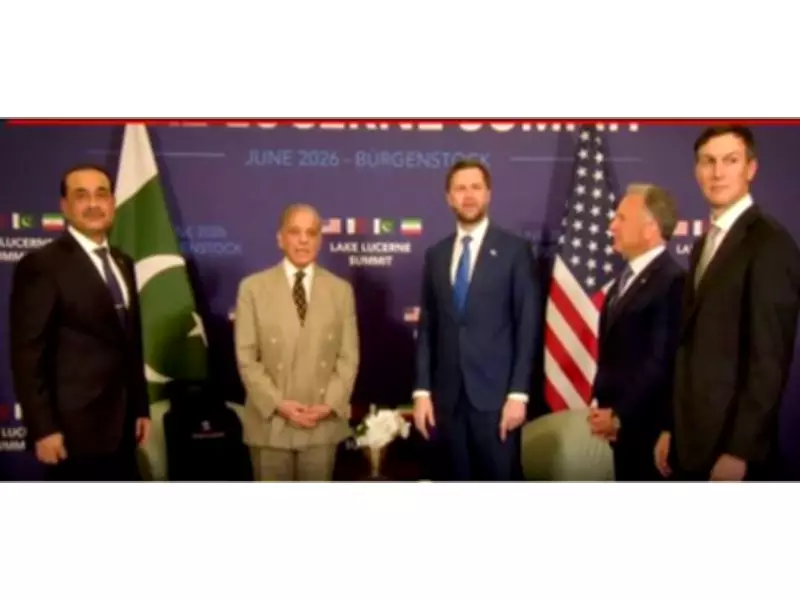
US Vice President JD Vance, Special Envoy Steve Witkoff, and Jared Kushner, senior advisor and son-in-law of President Donald Trump, met with Pakistan's Prime Minister Shehbaz Sharif and Army Chief General Asim Munir at the Burgenstock resort in Switzerland on Sunday. The meeting occurred hours before the scheduled negotiations between American and Iranian delegations, set for later that afternoon.
High-Level Delegations Exchange Handshakes
Members of the American delegation were seen exchanging handshakes with the Pakistani leaders. The meeting followed the arrival of Prime Minister Sharif, accompanied by Army Chief Munir and a high-level delegation, in Switzerland earlier on Sunday to participate in technical-level talks between the United States and Iran.
These talks are part of a broader diplomatic push to restore peace in West Asia. The negotiations are being conducted under a 14-point Memorandum of Understanding (MoU) finalized on June 17 by US President Donald Trump and Iranian President Masoud Pezeshkian. Pakistan, acting as a guarantor of the agreement, along with Qatar, is participating as a mediator.

US and Iranian Delegations Arrive in Switzerland
Vice President Vance landed in Switzerland earlier on Sunday, joining Witkoff and Kushner, who were already on site to handle the technical aspects of the dialogue. Concurrently, the Iranian delegation also arrived in Switzerland to present its terms. According to Iranian state television, Tehran's negotiating team includes parliamentary speaker Mohammad Bagher Ghalibaf and Foreign Minister Abbas Araghchi, along with officials from Iran's central bank and oil ministry.
The MoU initiated a 60-day window for negotiators to resolve key disputes and establish stability across West Asia. However, the technical-level talks, originally scheduled to commence on Friday, faced sudden delays primarily due to recent exchanges of fire between Israel and Lebanon, which threatened to derail the diplomatic timeline.
Strait of Hormuz Reopening and Energy Security
A primary objective behind these urgent negotiations is securing global energy corridors. The finalization of the MoU had prompted the reopening of the crucial Strait of Hormuz maritime route, which handles nearly 20 percent of global energy supplies under normal conditions. The waterway had been blocked since February 28 following joint military strikes by the US and Israel on Iran, which provoked retaliatory actions from Tehran.
However, contradictory reports emerged on Saturday. Iran claimed it had shut down the waterway again following an Israeli strike in Lebanon, whereas the United States maintained that the maritime route remained open. The outcome of the current talks could determine the stability of energy flows through this critical chokepoint.
Pakistan's Mediating Role and Regional Implications
Pakistan's involvement as a guarantor underscores its growing diplomatic role in West Asia. The meeting between Vance, Witkoff, Kushner, and the Pakistani leadership signals close coordination among the parties ahead of the formal negotiations. The success of these talks could have far-reaching implications for regional security and global energy markets.