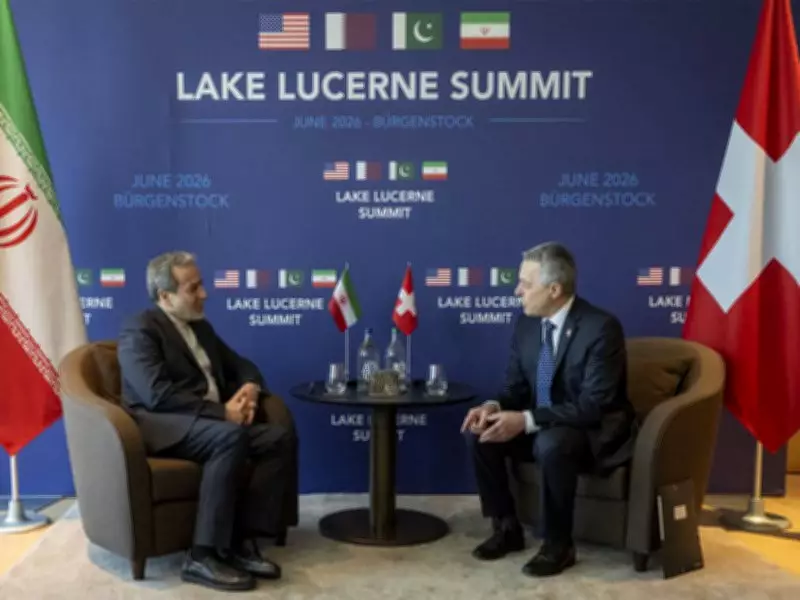
Swiss Foreign Minister Ignazio Cassis extended a welcome to Iran's top diplomat, Abbas Araghchi, as he arrived in Switzerland on June 21, 2026, to engage in diplomatic discussions with the United States. The bilateral engagement took place at the Burgenstock resort, setting the stage for high-stakes talks aimed at resolving core disputes in West Asia.
Switzerland's Role as Intermediary
Cassis posted an official photograph of his meeting with Araghchi on social media platform X, highlighting Bern's long-standing diplomatic role as an intermediary between Washington and Tehran. "Welcome to #Switzerland, H.E. Abbas @araghchi. At the Lake Lucerne Summit, we offer the framework for discussion and dialogue," Cassis wrote. He emphasized the endurance of Switzerland-Iran ties despite shifting geopolitical dynamics, stating, "In a challenging context, the relationship of trust between Switzerland and Iran, reflected in our protecting power mandate, remains in the service of diplomacy and for peace and security in the Middle East."
High-Profile Arrivals and Preliminary Meetings
The Swiss-hosted diplomatic push gained significant momentum on Sunday with the arrivals of both American and Iranian delegations. US Vice President JD Vance landed in Switzerland earlier on Sunday, joining American technical negotiators Steve Witkoff and Jared Kushner. Immediately upon arrival, the US team held a crucial preliminary meeting at the Burgenstock resort with the Pakistani mediating team, ahead of formal negotiations with the Iranian delegation scheduled for later in the afternoon. During this initial huddle, members of the American delegation exchanged handshakes with Pakistan's Prime Minister Shehbaz Sharif and Army Chief General Asim Munir. The high-level Pakistani delegation arrived in Switzerland shortly before the meeting to participate in technical-level talks, with Islamabad acting as a primary guarantor of the agreement alongside Qatar.

Framework of the 14-Point MoU
These high-stakes talks are being held under the framework of a 14-point Memorandum of Understanding (MoU) finalized on June 17, 2026, by US President Donald Trump and Iranian President Masoud Pezeshkian. The MoU has initiated a strict 60-day window for negotiators to resolve core disputes and restore stability in West Asia. According to Iranian state television, Tehran's negotiating team is heavily weighted towards economic and diplomatic leverage, comprising parliamentary speaker Mohammad Bagher Ghalibaf and Foreign Minister Abbas Araghchi, alongside senior officials from Iran's central bank and oil ministry.
Delays and Security Concerns
While these critical technical-level talks were originally scheduled to commence on Friday, the proceedings faced sudden delays due to recent exchanges of fire between Israel and Lebanon, which threatened to derail the diplomatic timeline. The primary objective behind these urgent negotiations remains the securing of global energy corridors. The initial finalization of the MoU had prompted the reopening of the crucial Strait of Hormuz maritime route, which handles nearly 20 percent of global energy supplies under normal conditions. The vital waterway had been blocked since February 28, 2026, following joint military strikes by the US and Israel on Iran, which provoked retaliatory actions from Tehran.
Contradictory Reports on Strait of Hormuz
However, entering Sunday's talks, the maritime situation remains fluid and contradictory. Tehran claimed on Saturday that it had shut down the waterway once again following an Israeli strike in Lebanon, whereas the United States maintained that the strategic shipping route remains open, adding a layer of economic urgency to the afternoon's proceedings. As the delegations positioned themselves at the resort, the world watches closely for any breakthrough that could restore stability in the region and secure global energy supplies.