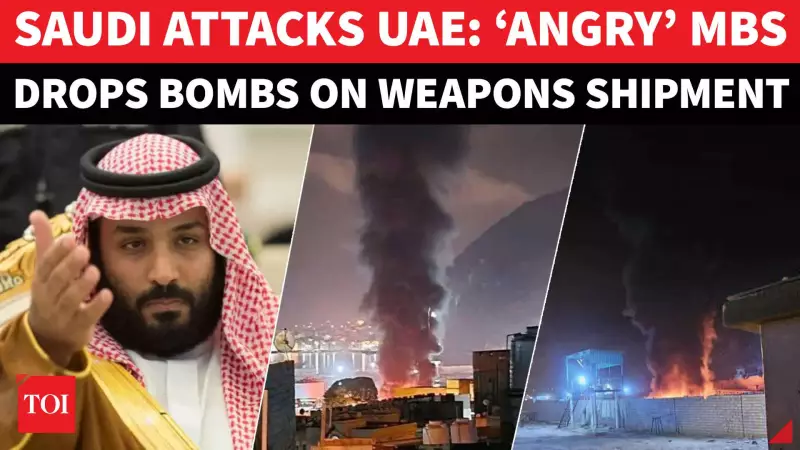
In a dramatic escalation that has laid bare a deepening rift between two key Gulf allies, Saudi Arabia launched airstrikes on the port of Mukalla in Yemen on December 30, 2025. The Saudi action targeted what it claimed were weapons shipments destined for UAE-backed separatist forces, marking a rare public confrontation between Riyadh and Abu Dhabi and threatening to reshape the complex landscape of Yemen's long-running conflict.
A Direct Strike and a Stark Warning
The Saudi-led coalition, which has been fighting Houthi rebels in Yemen for years, took the extraordinary step of bombing the port city of Mukalla, located in the country's east. The official justification from Riyadh was the interception of illicit arms shipments linked to the Southern Transitional Council (STC), a secessionist group that enjoys substantial political and military backing from the United Arab Emirates.
This military move was accompanied by a stern political message. Reports indicate that Saudi Crown Prince Mohammed bin Salman (MBS) delivered a clear ultimatum to the leadership of the UAE, represented by the Al Nahyan family. The core of the message was a blunt warning: "Don't cross our red line!" This phrase underscores Saudi Arabia's growing impatience with what it perceives as Emirati actions that undermine coalition unity and Saudi interests in Yemen, particularly the STC's push for an independent southern state.

The Unraveling of Gulf Unity
The airstrikes have violently exposed the simmering tensions within the Gulf coalition, which had largely managed to keep its internal disagreements out of the public eye. While both Saudi Arabia and the UAE joined the war against the Houthis, their long-term objectives in Yemen have increasingly diverged.
The UAE has focused its efforts on supporting local forces like the STC, which seeks to restore the former independent state of South Yemen. This goal often clashes with Saudi Arabia's preference for a unified Yemen under a friendly government in Riyadh's orbit. The attack on Mukalla port, a key logistical node, signals that Saudi Arabia is now willing to use military force to check the ambitions of its ally's proxies, directly challenging the UAE's strategy on the ground.
A Dangerous New Phase for Yemen
This intra-coalition clash plunges Yemen's war into an even more perilous and fragmented phase. The conflict is no longer a straightforward battle between the Saudi-backed government and the Iran-aligned Houthis. It is now increasingly marked by:
- Internal Rivalries: Open hostility between nominal allies Saudi Arabia and the UAE.
- Shifting Alliances: Local factions navigating the split between their powerful backers.
- Escalating Regional Power Struggles: The Saudi-UAE rift reflects broader competition for influence in the post-war order of the Arabian Peninsula.
The bold actions of the Southern Transitional Council in advancing its statehood agenda have acted as a catalyst, forcing the underlying tensions between Riyadh and Abu Dhabi to the surface. The situation creates a volatile multi-front environment where the primary conflict lines are constantly redrawn, complicating any path to peace and increasing the suffering of the Yemeni people.
The Mukalla port strike is more than a tactical military operation; it is a geopolitical statement. It reveals that the bonds of the Gulf coalition are fraying under the pressure of competing visions for Yemen's future. As both powers dig in, the warning from Riyadh serves as a stark reminder that the war's next major battles may not be against the Houthis, but between the very partners who started the intervention.