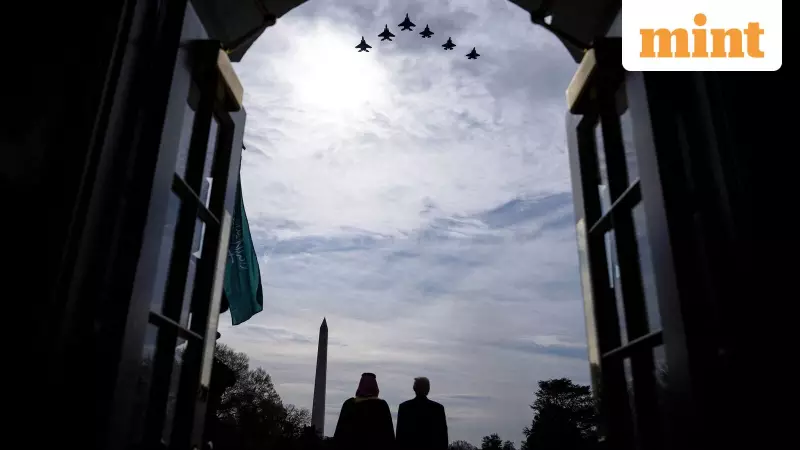
Israel has maintained complete air superiority across the Middle East for the past two years, conducting extensive military operations without losing a single aircraft. This remarkable achievement, according to former senior Israeli defense officials, stems largely from the country's advanced F-35 fighter jet fleet.
The Stealth Advantage in Regional Conflicts
Israel's F-35 jets have become the cornerstone of its military strategy, allowing the nation to dominate battlefields from nearby territories to locations over 1,000 miles away. The aircraft's capabilities were demonstrated dramatically during Israel's 12-day war against Iran in June, where stealth fighters effectively neutralized Iranian air defenses and established air superiority.
Former Israeli National Security Council head Eyal Hulata emphasized the critical role of air power, stating: "Our air force is our insurance policy. It is our long arm but also our quickest and most effective response to most situations."

Saudi Arabia's F-35 Ambitions Raise Concerns
The Trump administration's agreement to sell the advanced F-35 aircraft to Saudi Arabia has sparked significant apprehension within Israeli security circles. While the current Saudi government doesn't pose an immediate threat, Israel fears this sale could open doors for other regional powers like Turkey to acquire the same technology.
Yaakov Amidror, former Israeli national security adviser, explained the core concern: "The fact that Israel was the only country with F-35s in the region was very important. It gave us opportunities that allowed us to make operations without being exposed by others."
The fundamental worry is that Saudi Arabia gaining F-35s would enable them to detect Israeli stealth aircraft, potentially eroding Israel's qualitative military edge.
Technical Superiority and Regional Implications
The F-35 represents a technological leap in aerial warfare. Despite criticism from tech leaders like Elon Musk about its $100 million per plane cost and complexity, Israel has proven the aircraft's combat effectiveness across multiple theaters from Lebanon to Yemen to Iran.
These fifth-generation fighters combine extreme stealth capabilities with the ability to carry substantial payloads over 1,300 miles. More importantly, their advanced sensors, radar systems, and networking capabilities provide pilots with unprecedented battlefield awareness and the ability to coordinate with drone squadrons.
Assaf Orion, former head of strategy for the Israel Defense Forces, highlighted the success of Israel's F-35 operations: "When you look at the whole operation, with no human casualties, with only some unmanned platforms lost, it's a huge achievement. It shows you the level of air force that can be built around the F-35."
Broader Regional Security Considerations
Arab governments have taken note of Israel's military reach and precision, specifically citing their lack of F-35s as a concern in the regional power balance. Meanwhile, Israel faces growing quantitative disadvantages as countries like Egypt and Turkey undergo significant military buildups.
Hulata noted the strategic challenge: "Israel is struggling to maintain its qualitative military edge also because we are in a growing quantitative disadvantage. The force buildup in countries like Egypt and Turkey is tremendous."
The geographical proximity adds another layer of concern—Saudi jets based near the Israeli city of Eilat would be just minutes away from Israeli territory.
Potential Compensations and Future Scenarios
Despite these concerns, former officials from both Israel and the United States suggest that Israel can maintain military superiority through enhanced cooperation and access to newer technologies. The sale process itself could face obstacles in Congress or be derailed by other developments, as happened with the 2020 F-35 sale agreement to the United Arab Emirates that ultimately collapsed.

Daniel Shapiro, former U.S. ambassador to Israel and deputy assistant secretary of defense, indicated that mechanisms exist to address Israeli concerns: "There are all kinds of details about the capabilities, its basing, terms of use, and then of course what Israeli capabilities are that can counter any kind of threat."
Interestingly, the F-35 sale could potentially serve as leverage to encourage Saudi Arabia to normalize relations with Israel. Hulata suggested this strategic possibility: "What changes the power of balance in the Middle East is normalization between Israel and Saudi Arabia. To get that there are various things Israel should be expected to provide. One is approval of advanced weaponry."
The United States government is legally bound to preserve Israel's military advantage in the region, and Congress will consider Israel's security concerns before approving any F-35 transfer to Saudi Arabia. This complex interplay of technology, diplomacy, and regional security continues to shape the Middle East's evolving power dynamics.