

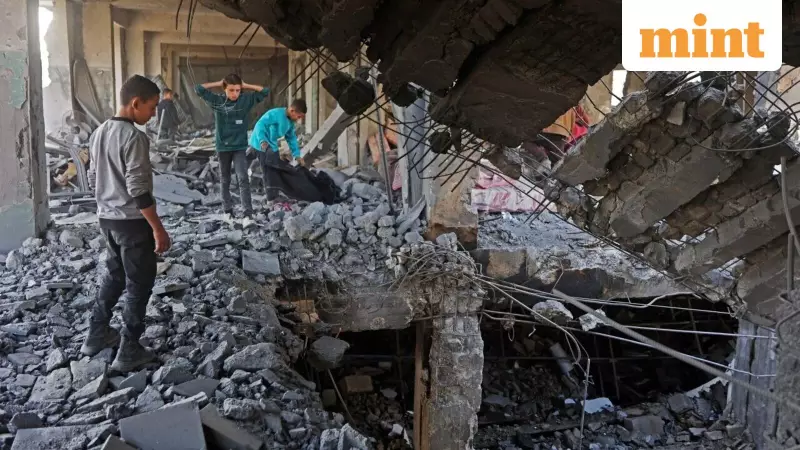
Despite official cease-fire agreements, fighting has erupted again in both Gaza and Lebanon, revealing the fragile nature of peace in a region caught between war and sustainable resolution. The recent violence represents some of the deadliest incidents since truces were established, underscoring how cease-fires in the Middle East often resemble ongoing conflict.
Recent Escalations Challenge Fragile Truces
Israel confirmed it carried out multiple strikes on Hamas targets in Gaza this Wednesday after militants allegedly fired toward Israeli troops. The very next day, Israel targeted what it identified as a Hamas training camp in Lebanon. These actions have resulted in significant casualties, with local health ministries reporting more than two dozen fatalities in Gaza and over a dozen in Lebanon.
Hamas has strongly denied both allegations, claiming they fired no shots in Gaza and that the Lebanese location struck by Israel was not a military camp but a civilian area. Despite these deadly exchanges, neither side has formally declared the cease-fires terminated, leaving the region in a precarious limbo.

The Unresolved Core Issues
The fundamental tensions that sparked the series of wars following Hamas's October 7, 2023 attack on Israel remain largely unaddressed. Israel continues to press its military advantage, having significantly weakened both Hamas and Hezbollah, and insists on their disarmament while reserving the right to attack if they refuse.
Meanwhile, the militant groups, though substantially diminished, are actively working to rebuild their forces and reestablish authority. Hamas security forces returned to Gaza's streets immediately after the cease-fire took effect last month, confronting rivals and reasserting control over the enclave.
In Lebanon, intelligence sources confirm that Hezbollah is reconstructing its military capabilities and replenishing its ranks. This has drawn increasing frustration from both Israel and the United States regarding the group's failure to disarm, raising the risk of further escalation.
Cease-Fire Agreements Stalled in Implementation
The Lebanon-Israel agreement from November last year halted a two-month war against Hezbollah. The deal stipulated that Israel would cease strikes and withdraw troops in exchange for the dismantling of Hezbollah's infrastructure in southern Lebanon and eventual disarmament. While Lebanon's government, with Israeli intelligence support, made progress in dismantling southern infrastructure, the broader disarmament process has stalled.
In Gaza, the Trump-brokered agreement called for an end to fighting, prisoner exchanges, increased humanitarian aid, and Hamas disarmament. Israel was to gradually withdraw troops as benchmarks were met, with an international security force and new administration taking over governance from Hamas.
Analysts note that both cease-fires remain stuck in early stages because multiple parties see advantages in this halfway state. Israel maintains attack capabilities while Hezbollah and Hamas delay disarmament, allowing the U.S. to showcase brokered deals while Arab governments postpone committing troops or funds that might conflict with Arab militias.
Randa Slim, a conflict resolution expert at Johns Hopkins University's Foreign Policy Institute, observed that "Israel is getting the best of two worlds. It shut down its opponents' firepower through these cease-fires, but at the same time has maintained its ability to attack and go after its opponents' assets any time it wants to."
Ongoing Military Presence and Operations
Hezbollah leader Naim Qassem has stated the group seeks to avoid another war with Israel and has refrained from military responses to Israeli strikes since the truce. However, Israel maintains troop presence in strategic southern Lebanon locations, with drones frequently flying over Beirut. Israel has struck Lebanon more than 1,000 times since the 2024 cease-fire and has begun constructing a wall that Unifil, the UN peacekeeping force, says encroaches on Lebanese territory.

In Gaza, Israeli troops have withdrawn from the heart of the enclave but still control over half the territory behind the so-called yellow line dividing combatants. Fighting continues with occasional Israeli strikes and Palestinian militant attacks, though less frequently due to heavy U.S. pressure. The U.S. Central Command has established a Civil-Military Coordination Center overseeing aid delivery and coordinating military activity with Israel.
The recent Israeli retaliation in Gaza was described as disproportionately massive by security analyst Ofer Guterman of Tel Aviv's Institute for National Security Studies. He explained that since Israel lacks full operational freedom in Gaza compared to Lebanon, it seizes opportunities to inflict significant damage when they arise.
The strikes have contributed to a mounting death toll, with Palestinian health authorities reporting approximately 280 Palestinians killed and hundreds more injured since the cease-fire began, though they don't specify combatant numbers.
Shifting Dynamics and Future Prospects
Paradoxically, Hamas's popularity has increased in Gaza as its security forces tackle criminal elements. While many Gazans oppose the group's reassertion of control, they welcome reduced crime and looting. Hamas repeatedly states it won't disarm without Israeli troop withdrawal and a clear path to Palestinian statehood.
Arab mediators reveal that Hamas has indicated willingness to dismantle heavy weapons and stockpile them under Egyptian and Palestinian Authority supervision if these conditions are met, though the group insists its personnel should retain small arms.
The region remains trapped in a gray zone where cease-fires have halted intensive warfare without delivering genuine peace, with all parties navigating the delicate balance between military advantage and political resolution.





