

Middle East Airspace Crisis Paralyzes Global Aviation Network
The Middle East has plunged into renewed uncertainty following coordinated military strikes by the United States and Israel against Iran, triggering immediate tensions that rapidly expanded beyond military zones into civilian airspace. Multiple cities reported explosions, but the ground-level shock proved temporary as the crisis quickly ascended to the skies.
Immediate Airspace Shutdowns and Flight Chaos
The initial impact manifested through commercial aviation as numerous countries began closing sections of their airspace within hours of the escalation. Airlines worldwide were forced into emergency response mode, canceling flights, rerouting aircraft mid-journey, and continuously reassessing safety protocols in real-time. The cascading effect of airspace closures created systemic disruption throughout global aviation networks.
Regional airports transformed into scenes of tension and overcrowding. Aircraft sat idle on tarmacs while departure boards displayed overwhelming red cancellation notifications. Anxious passengers repeatedly refreshed airline applications, seeking clarity that remained elusive as warnings and advisories continued to evolve.

Indian Airlines Face Unprecedented Route Challenges
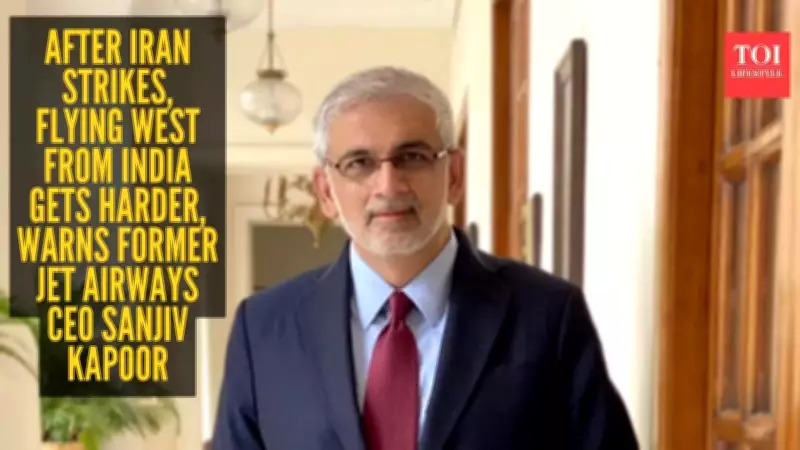
For Indian carriers, the situation presented particularly severe complications. Former Jet Airways chief executive Sanjiv Kapoor highlighted the crisis through a Flightradar24 map revealing how traditional westbound routes have effectively narrowed to critical levels. "Unfortunately, the north-south routes are not accessible to Indian airlines," Kapoor explained. "No Pakistan overfly, the north is blocked, and the south across Oman and Saudi Arabia is restricted due to DGCA directives. Consequently, finding westward routes from India has become extremely difficult."
In practical terms, airlines operating between India and Europe or North America are struggling to identify viable flight paths. Previously straightforward routes now require lengthy detours, increased fuel consumption, and complex scheduling adjustments. In some cases, flights have become completely impossible to operate.
Global Aviation Network Under Strain
This disruption extends far beyond Indian aviation. British journalist Gideon Rachman captured the broader dilemma in a social media post stating: "Now can't fly via the Gulf. Getting tricky to get to Asia." His observation underscores how geopolitical tensions are silently reshaping contemporary air travel patterns.
The past several years already forced airlines to reconsider routes due to Russian airspace restrictions. Now, instability in the Gulf region further narrows international flight corridors, creating unprecedented bottlenecks in global aviation.
Quantifying the Disruption
On Saturday, the full magnitude of the crisis became evident as multiple Middle Eastern nations closed or restricted their airspace in response to the attacks. Major global carriers including Air France, Air India, Turkish Airlines, Norwegian, Air Algerie, and Lufthansa announced widespread cancellations and schedule modifications, prioritizing safety over operational convenience.
Even major aviation hubs were not spared. Dubai International Airport and Al Maktoum International Airport suspended operations during peak uncertainty periods, stranding thousands of travelers in terminals and transit lounges.
According to aviation analytics firm Cirium, the impact proved extensive. Of approximately 4,218 flights scheduled to arrive in Middle Eastern nations on Saturday, 966 were canceled—representing nearly a quarter of all arrivals. When including outbound departures, total cancellations exceeded 1,800 flights.
Human and Operational Consequences
For travelers, the disruption translated into missed connections, postponed vacations, and lengthy, stressful airport queues. For airlines, it necessitated immediate flight plan revisions while balancing safety assessments, fuel budgets, and crew limitations.
The situation remains fluid as aviation authorities maintain continuous monitoring. Further schedule and route adjustments remain possible should tensions persist or escalate.

Geopolitical Stability and Global Connectivity
This incident serves as a stark reminder that geopolitical stability forms an invisible foundation for global air travel. Conflicts in specific regions can alter international flight paths virtually overnight, demonstrating how interconnected modern aviation has become.
Although the crisis originates in the Middle East, its repercussions are crossing borders globally as airlines, airports, and passengers worldwide navigate skies that have suddenly become significantly more complex and constrained.





