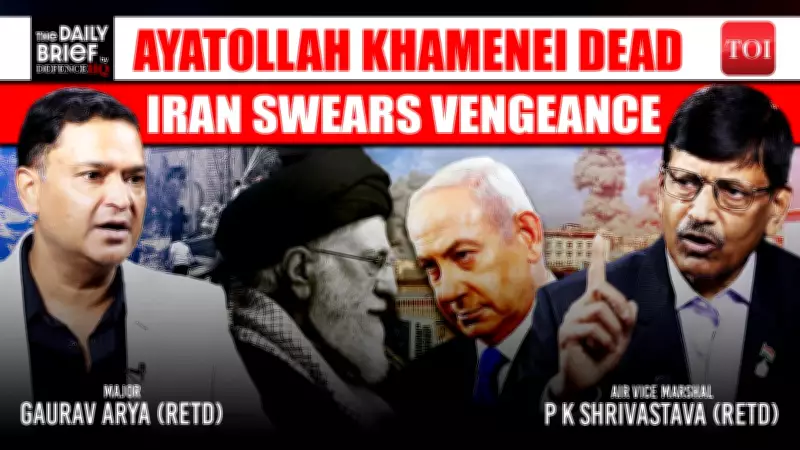
Supreme Leader Ali Khamenei Reported Dead: Iran's Retaliation and Regional Escalation Analyzed
In a dramatic development that has sent shockwaves across the Middle East, reports indicate the death of Iran's Supreme Leader Ali Khamenei. This news, amplified by former US President Donald Trump on Truth Social, has triggered immediate military responses and raised critical questions about the future of Iran's regime and regional stability.
Regime Change or Continuation of IRGC Ideology?
Defense experts are closely examining whether Khamenei's reported death signals genuine regime transformation in Tehran or merely represents the continuation of entrenched ideological control maintained by the Islamic Revolutionary Guard Corps (IRGC). The IRGC has historically been the primary power center behind Iran's revolutionary principles, and its influence over military and political decisions remains paramount.
Former Air Vice Marshal PK Shrivastava (Retd.), appearing on The Daily Brief by DefenceHQ with Major Gaurav Arya, emphasized that while leadership changes can create openings for political evolution, the IRGC's institutional dominance suggests continuity rather than radical departure from existing policies.
Tehran's Military Calculus and Retaliatory Strikes
Iran has already responded to what it perceives as provocations with coordinated missile and drone attacks across the Gulf region following recent US-Israel military operations. This retaliation demonstrates Tehran's capability to project power despite internal uncertainties.
The strategic analysis reveals several key elements in Iran's military planning:
- Hypersonic missile capabilities that challenge existing defense systems
- Naval choke point control in critical waterways
- The ever-present Strait of Hormuz factor that gives Iran leverage over global energy supplies
Military observers suggest Iran's escalation appears calculated to inflict punishment on Israel while carefully avoiding direct military confrontation with the United States—a delicate balancing act that reflects both capability and restraint.
Regional Chaos and Global Power Dynamics
The potential for wider regional conflict represents perhaps the most concerning aspect of this developing situation. As tensions escalate, several critical factors come into play:
- Gulf state positioning: Regional powers are carefully navigating their responses, balancing relationships with Iran against security partnerships with Western nations.
- Limited great power appetite: Both China and Russia have demonstrated restrained enthusiasm for direct involvement, preferring diplomatic channels over military engagement.
- Proxy network activation: Iran's extensive network of regional allies and militant groups could be mobilized, potentially expanding the conflict beyond state-to-state confrontations.
Three Possible Pathways Forward
Experts outline three distinct trajectories that could emerge from the current crisis:
Negotiated resolution: Diplomatic channels, potentially involving neutral intermediaries, could lead to de-escalation and political settlements addressing underlying grievances.
Regime collapse scenario: Internal power struggles following Khamenei's reported death could weaken Tehran's cohesion, potentially creating opportunities for opposition movements but also risking state fragmentation.
Dangerous escalation: Miscalculations or provocative actions could trigger a last-ditch military confrontation with unpredictable consequences for regional stability and global energy markets.
The coming days will prove crucial in determining which path prevails. As military posturing continues alongside diplomatic maneuvering, the international community watches anxiously, aware that events in Tehran could reshape Middle Eastern geopolitics for years to come.