

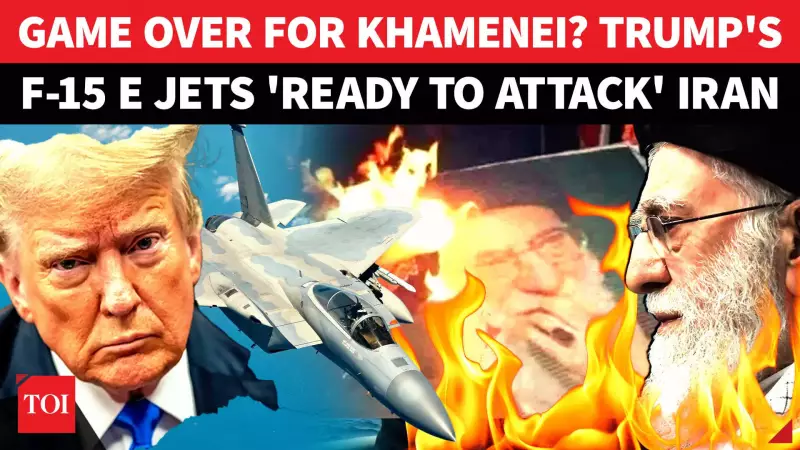
As chants of "Death to the Dictator" reverberate across major Iranian cities, the United States has taken a firm stance, with President Donald Trump putting the nation's Supreme Leader Ali Khamenei "on notice." The dramatic escalation comes alongside a visible US military posture, including the positioning of F-15E Strike Eagle fighter jets in the region, turning the spotlight on Iran's deepening internal crisis.
Protests Turn Volatile, US Issues Stern Warning
Widespread protests have erupted across Iran, with Tehran and Mashhad becoming epicentres of public anger. The situation on the ground has grown increasingly violent. Protesters have set buses on fire in Mashhad and targeted government buildings in Tehran with arson attacks. State television, in a rare admission, has been forced to broadcast images of the raging street fires, unable to conceal the scale of the unrest.
Human rights organisations monitoring the situation report a grim toll, indicating that dozens have been killed and thousands detained by security forces. From exile, Crown Prince Reza Pahlavi has called for the nationwide rallies to continue, adding a royalist dimension to the protests.

In response to the crackdown, President Donald Trump has issued a direct warning to Tehran's leadership. He has cautioned the regime against using violence on unarmed demonstrators, explicitly stating that Iran's leadership is now "on notice." This strong diplomatic language signals a potential shift in Washington's approach as it watches the crisis unfold.
Military Posturing and Regional Fallout
Amid the political turmoil, the United States has bolstered its military presence in the Middle East. F-15E Strike Eagle fighter jets have been deployed to the region. While US officials describe this move as part of a routine rotation, the timing is conspicuous, coinciding directly with the peak of the Iranian protests and Trump's stark warnings.
The instability is no longer confined within Iran's borders; it is causing ripples across the region. Air travel has been significantly disrupted, highlighting the growing sense of uncertainty. Several flights operating between Dubai and Iran have been canceled. Furthermore, Turkish Airlines has suspended its crucial Istanbul-Tehran routes. Inside Iran, widespread internet blackouts are being enforced, severely limiting communication and information flow.
A Pivotal Moment for Iran's Leadership
Iran's government now faces its most severe challenge in years, caught between massive domestic dissent and intense international pressure. Security forces are reportedly bracing for further unrest, particularly during Friday prayers, a traditional gathering point for demonstrations.
The convergence of factors creates a highly volatile scenario:
- Intensifying domestic protests with significant property damage and casualties.
- Direct US diplomatic pressure and warnings from President Trump.
- Tangible US military readiness with advanced aircraft in the theatre.
- Growing regional isolation evidenced by flight cancellations and connectivity blackouts.
The world is watching closely to see whether the Iranian leadership will choose a path of restraint or one of further escalation. The decisions made in Tehran in the coming days could define the country's trajectory for the foreseeable future, with implications far beyond its own borders.






