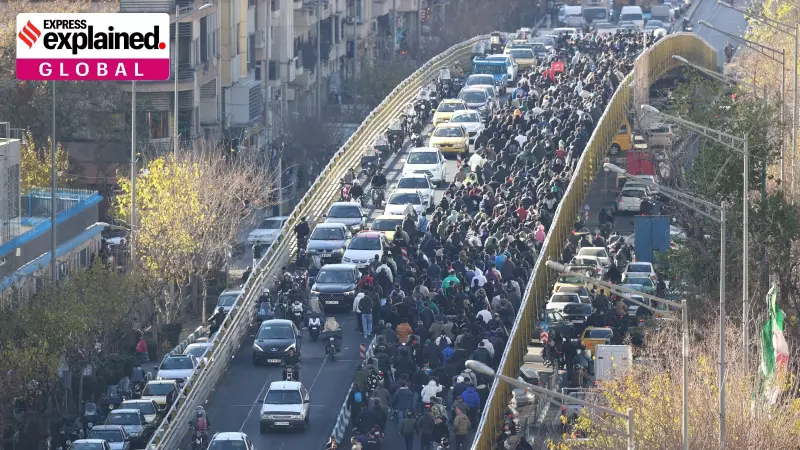
A fresh wave of public anger has swept across Iran, transforming what began as economic demonstrations by shopkeepers into a significant challenge against the ruling establishment. The unrest, which started in Tehran's Grand Bazaar on December 28, 2025, has now spread to at least 22 of the nation's 31 districts, highlighting deep-seated frustrations that go beyond immediate financial grievances.
The Economic Tinderbox: Inflation and a Crumbling Currency
The immediate spark for the current turmoil is a severe economic crisis. Official figures reveal that Iran's inflation surged by at least 30% over 2025, reaching over 52%, with monthly food inflation averaging a punishing 7%. The national currency, the rial, has been in freefall, losing more than half its value in the past year. It recently hit a historic low of 1.46 million rials to one US dollar.
In a bid to stabilise the economy, the government of President Masoud Pezeshkian announced key reforms on January 5, 2026. These included ending subsidies on essential imports and initiating direct cash and voucher transfers to most citizens, amounting to roughly $7 per month. However, these measures have done little to quell the public's fury, which has rapidly evolved from economic complaint to political defiance.

From Discontent to Defiance: The Protests' Anti-Regime Turn
The demonstrations have taken a deadly serious turn. Clashes between protesters and state security forces have resulted in the deaths of at least 36 people. The involvement of Iran's merchant class, the bazaaris, who have historically played pivotal roles in political movements, adds a potent layer to the current unrest.
International reactions have further inflamed tensions. On January 3, former US President Donald Trump stated America was "locked and loaded" to aid the protesters, a comment Tehran has seized upon as evidence of foreign meddling. This external pressure complicates the domestic landscape for the Iranian leadership.
History Repeating? Triggers Change, Grievances Remain
While the trigger for these protests is economic, the pattern of widespread anti-regime sentiment is familiar in 21st-century Iran. The last major nationwide upheaval occurred in 2022-23 following the death of Mahsa Amini, a social trigger. In 2009, it was a political trigger—the disputed presidential election. Each episode, whether sparked by social, political, or now acute economic pain, has consistently morphed into a broader rejection of the system led by Supreme Leader Ali Khamenei and enforced by the Islamic Revolutionary Guard Corps (IRGC).
However, the economic strain has intensified dramatically in recent years. US and UN sanctions over Iran's nuclear programme, including the recent reimposition of "snapback" sanctions and Trump's "Maximum Pressure" campaign, have exacerbated domestic troubles like foreign exchange crises and plummeting purchasing power. Internal mismanagement, evident during former President Ebrahim Raisi's tenure with crises over pensions and public sector wages, has also fueled the fire.
Regime Response and the Uncertain Road Ahead
Iran's clerical regime has a well-established playbook for dissent: limited concessions coupled with violent crackdowns, often led by the IRGC's Basij militia. This strategy helped it insulate itself from the Arab Spring over a decade ago. The current response shows a slight variation. While maintaining force, the state has also swiftly acknowledged the protesters' "legitimate demands," a conciliatory tone that aligns with President Pezeshkian's reformist image but is novel for the Islamic Republic.
Despite the scale of anger, analysts point to significant barriers to immediate regime change. The IRGC remains deeply invested in the current system and is unlikely to side with protesters or stand aside as the Shah's military did in 1979. Furthermore, there is little evidence that Iranians seek to dismantle the state's bureaucratic and social welfare institutions, fearing greater chaos.

The regime faces other vulnerabilities. Geopolitically, it is weakened by the loss of allies in Syria and Lebanon, and a dominant Israel. Internally, the nation is preparing for the sensitive eventual succession of the 86-year-old Supreme Leader, a transition the younger, dissatisfied generation has never witnessed. These factors make internal stability paramount for the regime's preservation.
The protests, while widespread, remain largely unorganized. Their snowballing nature points to uncertain outcomes rather than a neat political transition. The Iranian government's immediate challenge is to address the profound economic suffering without ceding political ground, a balancing act that is becoming increasingly difficult to maintain as public patience wears thin.