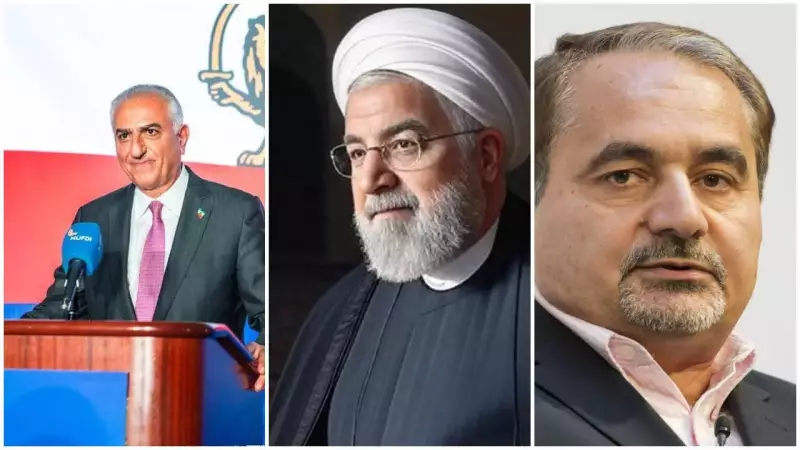
As Iran's Islamist regime faces sustained internal pressure after over four decades of rule, international experts are analysing potential successors who could ascend to power if the current government falls. A report highlights an exiled prince and a former president among the top figures who could lead a post-revolutionary Iran.
The Exiled Crown Prince's Resurgent Influence
One prominent name is Reza Pahlavi, the 65-year-old former crown prince. He fled to the United States as a teenager in 1978, a year before the 1979 revolution overthrew his family's Pahlavi dynasty. Now based in Maryland, Pahlavi has spent years cultivating relationships with officials in Washington D.C. and within the widespread Iranian diaspora community.
"Pahlavi is a complicated character, but without a doubt he has a certain following inside of the country," stated Reuel Marc Gerecht, a former CIA officer focused on Iran. He added that nostalgia for the pre-revolution era has grown as the Islamic Republic's "charisma has cratered," leading to Pahlavi's standing increasing, "if not skyrocketed."

A tangible sign of his digital influence came when Pahlavi called for protests on January 8 and 9. His message on Persian Instagram garnered a massive 3.2 million likes and 88 million views. The son of the last Shah, Mohammad Reza Pahlavi, recently clarified his position in a Washington Post op-ed. He insisted he seeks a "transition to democracy" for Iran, not a restoration of the monarchy. "I have therefore stepped forward to lead and serve in that capacity: not as a ruler-in-waiting, but as a steward of a national transition to democracy," he wrote.
While some question whether someone absent for so long can command nationwide support, his recent call to action did inspire some street protesters to chant for his return.
Internal Figures and the Security Apparatus
Another potential contender from within the system is former President Hassan Rouhani. The cleric served as Iran's seventh president from 2013 to 2021 and made history as the first Iranian leader to hold direct talks with a U.S. president, speaking with Barack Obama by phone in 2013. His moderate stance and calls for dialogue with the West often drew criticism from hardliners within the Iranian government.
According to Iran expert Ali Reza Nourizadeh, Rouhani is now under "hard scrutiny" by the regime. "They're listening to his telephone. They are watching him. So therefore they believe that the Americans are talking with people" inside Iran through him, Nourizadeh explained.
Another rumoured name is Sayed Hossain Moussavian, a former ambassador to Germany and nuclear negotiator (2003-2005) who also spent time at Princeton. Andrew Apostolou of the Britain Israel Communications and Research Center described Moussavian as part of a clique with a sharp "survival instinct."
Ultimately, experts suggest that raw power may decide Iran's future leadership. Alireza Nader, an Iran scholar, posits that the next leader might emerge from one of Iran's many security services. "It's not going to be a person per se. What forces can come in and take control of the streets?" he asked, emphasizing that "Ultimately, it's forces on the ground." He offered a grim prediction, noting that "As long as the regime sticks together, they're going to kill a lot of people before it comes to that."
A Nation at a Crossroads
The analysis underscores the complex and volatile political landscape in Iran. The potential for change pits external symbols of the past, like Pahlavi, against internal reformist figures like Rouhani, with the ever-present possibility of a military or security-led takeover. The enduring strength of the current regime and its willingness to use force remain the most significant barriers to any immediate transition. However, the identification of these key figures provides a framework for understanding the power vacuums and alliances that could define Iran's future if the decades-old Islamist rule were to end.