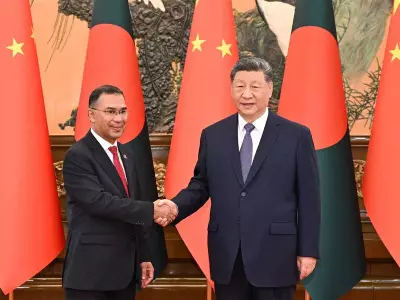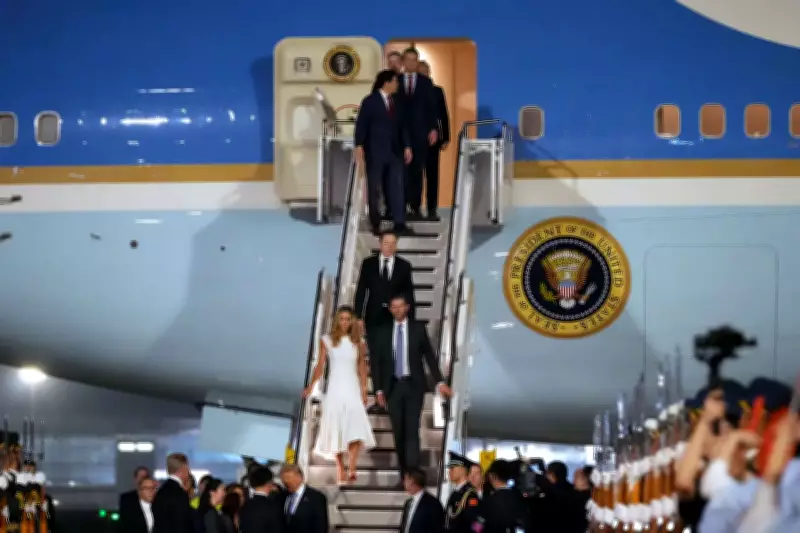
A delegation of 16 American CEOs, whose companies boast a combined market capitalization of $16.47 trillion, accompanied President Donald Trump to Beijing this week for a high-stakes summit with Chinese President Xi Jinping. This staggering figure represents roughly 82% of China's projected 2025 GDP and surpasses the annual economic output of every nation except the United States and China itself. The 36-hour meeting places two governments on one side of the negotiating table and the largest private concentration of capital ever assembled for a state visit on the other.
Last-Minute Addition: Jensen Huang
Nvidia's Jensen Huang was nearly absent from the delegation. The White House released its list of 16 executives on Monday, and his name was missing. However, Trump called Huang on Tuesday morning, prompting him to fly to Anchorage and board Air Force One during its Alaska layover. Nvidia alone is valued at $5.37 trillion. Combined with Apple's $4.33 trillion, Huang and Tim Cook represent nearly $9.7 trillion in cabin value—more than the economies of Japan, Germany, and the United Kingdom combined.
Nvidia and Apple Outweigh Three G7 Economies
The remainder of the delegation leans heavily toward Wall Street, semiconductors, and aerospace. Elon Musk brings Tesla ($1.67 trillion), the only automotive company on the plane, which has a significant Shanghai gigafactory to protect. Boeing's Kelly Ortberg is present, with a large aircraft order reportedly on the agenda. The finance bloc includes BlackRock's Larry Fink, Goldman Sachs' David Solomon, Citi's Jane Fraser, and Blackstone's Stephen Schwarzman. Micron ($847 billion) and Qualcomm flank Nvidia in the chip sector. Visa, Mastercard, GE Aerospace, Illumina, Coherent, and Cargill round out the list. Cargill, the only private firm on the plane, uses its $154 billion in annual revenue as a proxy for market capitalization.

This trip also marks one of Cook's final major diplomatic moves at Apple. He announced last month that he will hand the CEO role to hardware chief John Ternus on September 1. Cook spent both Trump terms negotiating exemptions and shifting iPhone production—first to India for the US market, then promising $600 billion in American investment—to shield Apple from the worst of tariff conflicts. Beijing has been closely monitoring this pivot.
A Delegation Built Around AI Chips, Trade, and Taiwan
Trump's own framing of the trip, in a post after takeoff, indicated he would ask Xi to 'open up' China so his 'brilliant people' could 'work their magic.' He named Jensen, Elon, 'Tim Apple,' Larry Fink, Stephen Schwarzman, Kelly Ortberg, Brian Sikes, Jane Fraser, Larry Culp, David Solomon, Sanjay Mehrotra, and Cristiano Amon, promising this would be his first request to Xi. The pitch essentially is: I have brought you my best people; now let them sell.
The catch is that for most of the tech names on the plane, the door has already been pried open, and Beijing is the one keeping it half-shut. Huang's entire reason for being there is the H200 chip. He has pegged China as a $50 billion opportunity for Nvidia and has spent nearly a year lobbying officials on both sides. The Trump administration cleared export licenses months ago, with conditions—a third-party review of each shipment, a 50% cap relative to US customer sales, and a ban on military use. In March, Huang stated Nvidia had permission to ship to 'many customers' in China and was ramping up production. Then Beijing did not move. Chinese firms that placed orders quietly told Nvidia they could not fulfill them, and Commerce Secretary Howard Lutnick said in April that no H200s had actually shipped because the Chinese government was steering funds toward Huawei instead. Beijing also rejected the less advanced H20s outright last year. Nvidia's most powerful chips—Blackwell and the upcoming Rubin—were not part of the approved list at all. 'Open up' is exactly what Huang needs Xi to do.

Meta's Dilemma
Meta is on the plane with the opposite problem—Trump did not name-check it in his post, and the company did not send its CEO. In late April, China blocked Meta's $2 billion acquisition of Manus, a Singapore-registered AI startup with Chinese founding roots. Beijing's state planner ordered the deal unwound, and the decision was reportedly escalated to the National Security Commission chaired by Xi himself. The state-run Global Times argued that Manus's R&D, data, and engineering talent all originated in China, and that re-registering offshore did not change the underlying ownership of the technology. Meta had already integrated Manus into its internal systems and onboarded the startup's executives. Unwinding any of that will be messy. The company sent Dina Powell McCormick, its president of global affairs, instead of Mark Zuckerberg.
Chip CEOs with Specific Damage to Repair
Mehrotra and Amon, the two chip CEOs Trump did name, both have specific damage to repair. Qualcomm's stock dropped 11% on Tuesday, the day Trump's plane took off, as chip stocks pulled back from a record AI-driven rally. The company derives a sizeable chunk of its revenue from Chinese smartphone makers, and its modem business has been a recurring pressure point in US-China tech talks. Micron is in a similar bind—Beijing banned its memory chips from critical infrastructure projects back in 2023, and the company has spent the years since trying to claw back its position in a market it once depended on.
The smaller tech names rounding out Trump's 'and many others' have their own reasons for showing up. Coherent, up 292% over the past year on AI data center demand, makes the optical networking gear that ties Nvidia clusters together—and a lot of that gear is assembled or sourced through Chinese supply chains. Illumina spent two years on a Chinese sanctions list over its 2021 Grail acquisition and was only removed earlier this year, so the trip is a chance to reset relations with regulators it has been fighting in court. Cisco's Chuck Robbins is on the plane representing the only major American networking vendor still trying to do meaningful enterprise business inside China after years of being squeezed out by Huawei.
A note on the math: market cap and GDP are not apples-to-apples. In PPP terms, China's economy is closer to $43.8 trillion.