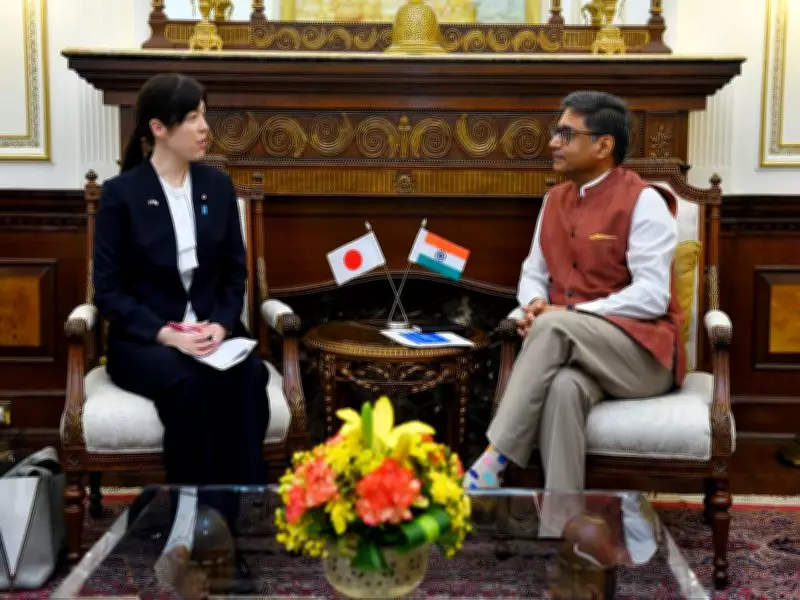
Foreign Secretary Vikram Misri held a meeting with Japan's Minister for Economic Security, Sanae Takaichi, in New Delhi on Wednesday, where both sides agreed to deepen bilateral cooperation to build resilient and diversified supply chains. The discussions centered on enhancing collaboration in critical sectors such as semiconductors, critical minerals, and emerging technologies, reflecting a shared commitment to economic security and strategic autonomy.
Key Areas of Discussion
The meeting focused on several key areas aimed at strengthening the economic partnership between India and Japan. Both leaders emphasized the importance of reducing dependence on single-source supply chains, particularly in high-tech industries. They agreed to work together to identify and mitigate vulnerabilities in supply chains, ensuring a stable flow of essential goods and components.
Semiconductors and Critical Minerals
A major part of the talks revolved around semiconductors and critical minerals, which are vital for modern economies. India and Japan intend to collaborate on research, development, and production of semiconductors, leveraging Japan's technological expertise and India's growing manufacturing capabilities. Similarly, cooperation in critical minerals will focus on securing access to rare earth elements and other materials essential for electronics, renewable energy, and defense applications.

Emerging Technologies and Economic Security
Both sides also discussed emerging technologies such as artificial intelligence, quantum computing, and cybersecurity. They agreed to promote joint research and innovation, while also addressing security concerns related to technology transfer and data protection. The ministers underscored the need for a rules-based international order that supports open and fair trade, while safeguarding national security interests.
Strategic Significance
This meeting is part of broader efforts by India and Japan to strengthen their strategic partnership under the India-Japan Special Strategic and Global Partnership. Both countries share common concerns about supply chain vulnerabilities exposed by the COVID-19 pandemic and geopolitical tensions. By deepening ties, they aim to enhance their economic resilience and reduce reliance on any single country for critical supplies.
The agreement also aligns with India's Atmanirbhar Bharat (Self-Reliant India) initiative and Japan's Economic Security Promotion Act, both of which emphasize domestic production and diversification of supply chains. The two nations are expected to follow up with concrete action plans, including joint investments and technology-sharing agreements, in the coming months.
Foreign Secretary Misri's visit to Japan earlier this year laid the groundwork for these discussions, and the latest meeting marks a significant step forward in implementing shared goals. The talks are also seen as a precursor to the upcoming India-Japan annual summit, where supply chain resilience is expected to be a key agenda item.