India and European Union Seal Historic Free Trade Agreement After Two Decades of Negotiations
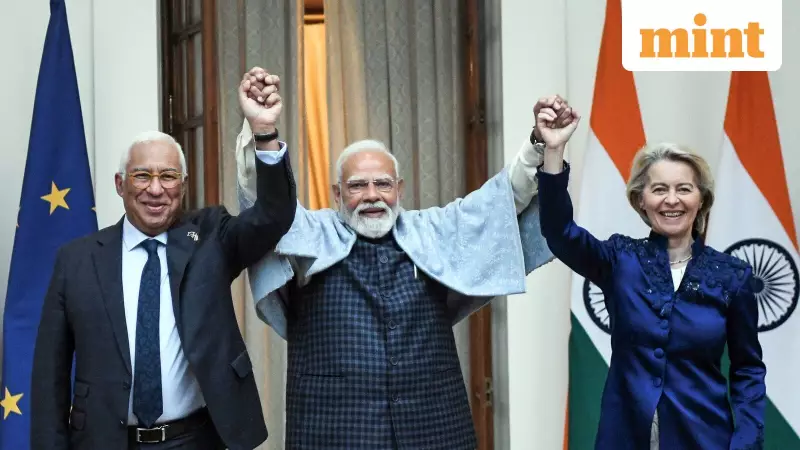
Prime Minister Narendra Modi held a significant bilateral meeting with European Council President Antonio Luis Santos da Costa and European Commission President Ursula von der Leyen at Hyderabad House in New Delhi. The high-level discussions, part of the European leaders' state visit to India, marked a pivotal moment in international trade relations.
EU High Representative for Foreign Affairs and Security Policy Kaja Kallas also participated in the landmark meeting, which culminated in the announcement of what European Commission President Ursula von der Leyen described as "the mother of all deals."
A New Era in India-EU Relations
"We are making history today by concluding this monumental agreement," declared von der Leyen in a social media post following the meeting. "We have created a free trade zone encompassing two billion people, with both sides positioned to reap substantial benefits. This represents only the beginning of what promises to be an even stronger strategic relationship."

The formal India-EU Free Trade Agreement (FTA) is expected to be officially signed within six months, according to diplomatic sources. This comprehensive pact will significantly enhance collaboration between India and the European Union across multiple critical policy domains including trade, security and defense cooperation, clean energy transition initiatives, and people-to-people exchanges.
Why This Agreement Matters
The finalized agreement concludes approximately two decades of intensive negotiations and partnership-building between two of the world's largest democratic markets. The Ministry of External Affairs highlighted the remarkable evolution of India-EU relations, tracing their journey from initial diplomatic recognition in the 1960s to the establishment of annual summits and joint initiatives in the 21st century.
India demonstrated early commitment to European partnership by becoming one of the first nations to establish diplomatic relations with the European Economic Community in 1962, the precursor to today's European Union. This historical foundation has now culminated in what experts are calling a transformative economic partnership.
Strategic Timing Amid Global Uncertainty
The timing of this agreement carries particular significance against the backdrop of heightened geopolitical turbulence and market volatility. Current global challenges include shifting trade policies under the Trump administration in the United States and the ongoing Russia-Ukraine conflict, which continues without clear resolution.
The United States has already expressed reservations about the timing of this landmark agreement. US Treasury Secretary Scott Bessent publicly criticized the European Union for finalizing a trade pact with India while trade negotiations between New Delhi and Washington remain ongoing.
"We have imposed 25% tariffs on India for purchasing Russian oil," Bessent told ABC News. "Yet last week, the Europeans signed a comprehensive trade deal with India."
The US official further accused European nations of indirectly financing the Russia-Ukraine conflict through energy trade mechanisms, suggesting that Russian oil refined in India ultimately reaches European markets as processed petroleum products.
Economic Implications and Benefits
The European Union maintains its position as India's largest trading partner for goods, with bilateral trade reaching approximately $136 billion during the 2024-25 fiscal year. The EU consistently ranks among India's top overall trading partners across both goods and services sectors.
Once implemented, the FTA is projected to substantially boost trade between India and EU member states. This development aligns with global efforts to diversify and de-risk supply chains amid increasing trade disruptions under current US policies.
According to earlier reports, the trade agreement will likely provide duty-free access for over 90 percent of Indian goods entering the vast EU market, which encompasses 27 member countries including economic powerhouses like Germany, France, Italy, Spain, and Belgium.

Specific Advantages for Both Economies
European Union statements indicate that the agreement will eliminate or substantially reduce tariffs on over 90% of EU goods exports to India, potentially saving European exporters up to €4 billion annually in duties. The pact represents the most significant trade opening India has granted to any international partner.
Key benefits outlined in official statements include:
- Simplified customs procedures to expedite exports
- Enhanced protection for EU intellectual property including trademarks
- Competitive advantages for EU exporters through unprecedented market access
India has committed to granting the European Union tariff reductions exceeding those offered to any other trading partner, dramatically improving market access for European exports across multiple sectors.
Sector-Specific Impact
The agreement includes substantial tariff reductions across critical industries:
- Automotive tariffs will gradually decrease from 110% to 10%, with an annual quota of 250,000 vehicles
- High tariffs reaching 44% on machinery will be largely eliminated
- Chemical sector tariffs up to 22% will see significant reduction
- Pharmaceutical tariffs as high as 11% will be mostly removed
This comprehensive trade agreement represents a strategic realignment in global economic partnerships, positioning India and the European Union as collaborative leaders in an increasingly multipolar world economy. The creation of this two-billion-person free trade zone marks a historic milestone in international trade relations with far-reaching implications for global commerce patterns.