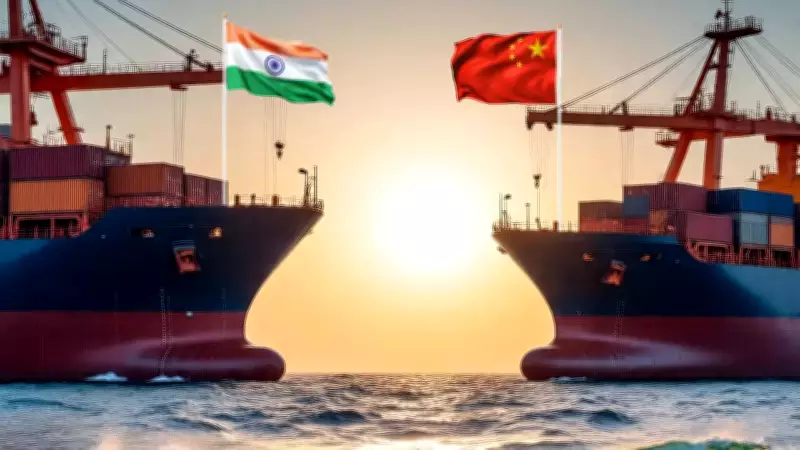
India is adopting a strategic approach in its trade relationship with China, aiming to expand exports and strengthen domestic manufacturing while gradually reducing its dependence on Chinese inputs. A senior government official told PTI that the focus is on maintaining balance rather than pursuing a complete break from Beijing.
Balanced Approach to Trade
The official stated that India is boosting exports to China by strengthening domestic production and diversifying its supplier base, while continuing to rely on Chinese inputs as a full decoupling is not feasible. “While India may not have hard decoupling from China, it is creating its own capacity both in terms of having resilient supply chain and also in terms of increasing our own exports capacity,” the official said.
Dependence on Chinese Inputs
The official explained that India largely brings in raw materials, intermediate goods and capital equipment from China. These include auto components, electronic parts and assemblies, mobile phone components, machinery and related parts, and active pharmaceutical ingredients, all of which deliver finished products, feeding into domestic manufacturing and exports. “Whatever China is supplying is the backbone of India's production. Some consumer durables are also coming but are less in numbers,” the official said.

Trade Data Trends
Trade data reflects this dependence alongside growing export momentum. India’s exports to China rose about 37% to $19.47 billion in 2025-26, up from $14.25 billion in 2024-25. In contrast, imports from China increased 16% to $131.63 billion from $113.44 billion during the same period, widening the trade deficit from $99.2 billion to $112.6 billion. For perspective, exports were just $0.71 billion and imports $1.11 billion in 1997-98.
Export Growth Sectors
Export growth in the past financial year has been seen in sectors such as printed circuit boards, electrical appliances, telephone systems, shrimp, aluminium ingots, black tiger shrimp, vessels and certain agricultural commodities. Even so, the official indicated that India needs to broaden its export basket further to increase its share in China’s imports.
Import Drivers
At the same time, the rise in imports has been driven by demand for electronics, electrical machinery, pharmaceutical ingredients, APIs, auto parts, telecom instruments, industrial machinery, computer hardware and peripherals, organic chemicals, batteries, plastic raw materials, residual chemicals and bulk drugs. “These all goods are ultimately going into our industrial process, as we are industrialising, imports will increase naturally,” the official added.
Government Measures to Address Imbalance
To address this imbalance, the government is stepping up efforts to boost domestic manufacturing. The production-linked incentive (PLI) scheme remains a key part of this push, helping businesses build value chains within the country, though industries still require imported capital goods and intermediate inputs. In addition, the government is identifying products where dependence on China is high and costs are competitive, and is exploring sourcing options from markets such as Taiwan, South Korea, Japan and the European Union.
An Inter-Ministerial Committee (IMC) has been set up to keep a close watch on trade flows and take corrective action when needed. The panel includes representatives from the Department of Commerce, Department of Revenue, Department for Promotion of Industry and Internal Trade, Directorate General of Foreign Trade and Directorate General of Commercial Intelligence and Statistics.