

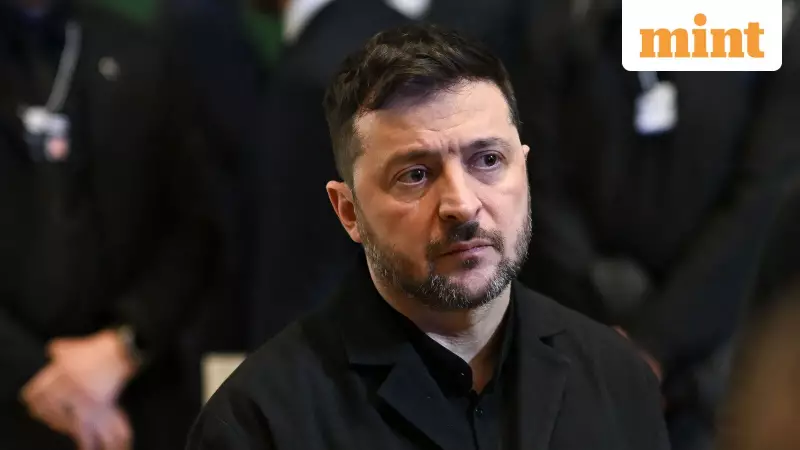
In a compelling guest commentary for Barrons, senior economist Howard J. Shatz presents a visionary analysis of Ukraine's economic future, arguing that once peace is secured, the nation will emerge as the defining business opportunity of the coming decade. This perspective comes amid high-level diplomatic discussions, including a meeting between President Donald Trump and Ukrainian President Volodymyr Zelensky at the World Economic Forum in Davos, Switzerland, where both leaders expressed optimism about progress toward ending Russia's war.
From Conflict to Catalyst: Ukraine's Economic Rebirth
At first glance, Russia might appear to be the more attractive market with its population of 140 million, a $2.2 trillion economy, and vast natural resources. However, Shatz contends that even after hostilities subside, Russia will remain burdened by high political and commercial risks, severely limiting investment opportunities. In stark contrast, Ukraine's outlook is remarkably brighter. Although Ukraine's real gross domestic product currently sits more than 20% below its prewar level, the cessation of conflict will trigger an economic transformation of historic proportions.
The Largest Reconstruction Project Since World War II
The immediate aftermath of the war will see Ukraine become the site of the most extensive reconstruction effort since World War II. The World Bank estimates that over $500 billion will be invested in the country over the next decade. This monumental undertaking will create vast opportunities across multiple sectors, from infrastructure and energy to technology and logistics. One particularly strong area will be defense technology, where Ukraine has become a global model for innovation. Ukrainian firms are already collaborating with U.S. companies to develop advanced prototypes, such as long-range unmanned aerial systems, offering a strategic partnership that engagement with Russia—which relies heavily on China for defense materials—cannot provide.

A Legacy of Reform and Resilience
Ukraine's economic journey has been one of profound transformation. Following independence in 1991, the country arguably had the worst economic record among former Soviet states. By 2013, its business environment was plagued by complex tax codes, byzantine regulations, poor corporate governance, weak contract enforcement, and widespread corruption, as noted in a U.S. Department of State report. However, significant reforms have since revitalized its investment climate.
The banking system underwent a major restructuring, with banks accounting for over one-third of assets being closed and others recapitalized. Reforms in gas pricing and management enabled the state-owned company Naftogas to contribute 1% of GDP to the national budget in 2019, helping to reduce the stubborn budget deficit. These changes did not go unnoticed by U.S. multinationals, whose sales in Ukraine surged from less than $6 billion in 2014 to nearly $11 billion in 2021, just before Russia's full-scale invasion. During the same period, their sales in Russia declined.
Digital Transformation and EU Aspirations
Remarkably, Ukraine continued its reform agenda even after the invasion. The Ministry of Digital Transformation launched new features on its mobile app, Diia, enabling business registration, tax payments for foreign nationals, and streamlined government services. Last year, a new public-private partnership law was passed to simplify processes and expand funding sources for national rebuilding.
Ukraine's bid to join the European Union, initiated just four days after the Russian invasion, will compel ongoing reforms. Since applying for membership, Ukraine has climbed to 105th out of 180 countries in Transparency International's Corruption Perceptions Index, surpassing nations like Brazil and Turkey. Russia, by contrast, has fallen to 154th. Although EU membership is years away, Ukraine already enjoys a comprehensive free trade area with the bloc, granting U.S. companies producing in Ukraine access to both the Ukrainian market and the entire EU—the world's second-largest economy.

Strategic Investments and First-Mover Advantage
The U.S.-Ukraine Reconstruction Investment Fund, established last April, will further support investments in critical areas such as minerals, energy, transport, logistics, information technology, and emerging technologies. Jointly funded by both nations, the fund will reinvest royalties from new resource developments back into Ukraine's economy.
Even during the war, thousands of U.S. and other foreign businesses have established operations in Ukraine. A recent survey by the American Chamber of Commerce Ukraine revealed that CEOs and managers view entering the market before full-scale reconstruction begins as crucial for gaining a first-mover advantage. This proactive approach underscores the confidence in Ukraine's long-term potential.
Russia's Grim Outlook Versus Ukraine's Optimistic Future
While Ukraine charts a path toward growth, Russia faces a bleak economic horizon. Its wartime economy is highly distorted, slowing, and increasingly centralized, with weak rule of law and unreliable contract enforcement. It remains uncertain whether Russian leadership is willing to undertake the monumental challenge of transitioning from a wartime to a civilian economy. Furthermore, Western sanctions are likely to persist for years, compounding these difficulties. Business opportunities in Russia may exist but will likely be accessible only to the largest players capable of bearing extreme risks.
In contrast, Ukrainians look toward an optimistic future aligned with the West. With sustained support from the U.S. and Europe, Ukraine is poised to emerge as a secure, sovereign state deeply integrated into the global economy. When peace finally takes hold, Ukraine will not only stand as a symbol of resilience but will also represent the most significant business opportunity of the decade, reshaping emerging markets and offering unparalleled prospects for innovation and investment.





