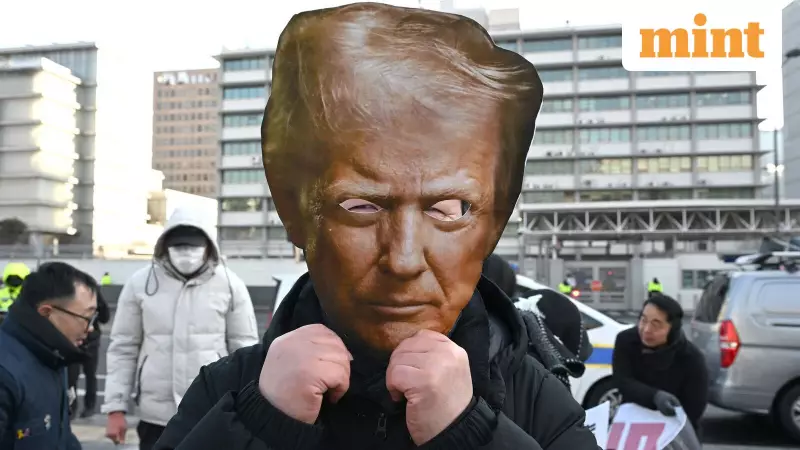
Trump's Tariff Threat on South Korea Rattles Global Trade Partners
President Donald Trump has sowed fresh doubts about the durability of his international trade agreements this week by vowing to resurrect tariffs on South Korea, despite a bilateral accord reached last fall. This unexpected move has sent shockwaves through global trade circles, forcing partners to reconsider the stability of deals negotiated with the Trump administration.
Sudden Reversal on South Korean Tariffs
On Monday, President Trump announced that South Korea's reciprocal tariff rate, along with levies on automobiles and other key sectors, would increase back to 25% from their current 15%. He cited delays in South Korea's legislature approving a pact struck in late October with President Lee Jae Myung as justification for this reversal. Trump did not specify when these tariff increases would take effect, leaving Seoul officials scrambling to respond.
South Korean officials expressed surprise at Trump's announcement, convening an emergency meeting and redirecting their industry minister from Canada to Washington, D.C. for urgent discussions. This development underscores a fundamental asymmetry in Trump's approach to trade deals: while they exist at the executive level in the United States, other nations often require legislative and regulatory approval that can take months or even years to secure.

The Fragility of Executive-Level Trade Agreements
The Trump administration has negotiated more than a dozen trade agreements with various partners including the European Union, Japan, the United Kingdom, and several Latin American and Southeast Asian nations. Nearly all of these agreements lack legally binding status, typically spanning just one or two pages in length. Many, including those with the EU and South Korea, have not yet received final legislative approval—a process that typically requires extensive deliberation.
Deborah Elms, head of trade policy at the Singapore-based Hinrich Foundation, observed: "Trump would like everyone else to be able to snap their fingers and respond with the speed he currently does. That is not true in most other countries. That is not a process allowed in most other places."
This discrepancy creates significant challenges for implementation. For instance, waiving tariffs on American products often requires partner nations to amend their tax codes and establish new regulations—procedures that cannot be expedited through executive fiat alone.
Global Implications and Legal Uncertainties
The potential reversal of South Korea's trade pact follows similar tariff threats recently aimed at Canada and several European nations. The European Parliament temporarily froze its approval process for last summer's EU-U.S. trade deal in response to Trump's threats of tariffs on countries opposing his efforts to take control of Greenland. Although Trump later called off those threats, lawmakers plan to re-evaluate the situation next week according to Bernd Lange, who chairs the body's international trade committee.
Several factors contribute to the uncertainty surrounding these trade arrangements:
- The legality of tools Trump used to impose tariffs currently rests with the Supreme Court, which could issue a ruling next month
- The lack of Congressional involvement means future American presidents could easily reverse course
- Political divisions in partner nations create additional delays in ratification processes
This uncertainty has prompted some countries to adopt a cautious approach when negotiating or completing deals with the United States.
South Korea's Specific Challenges
The South Korean situation illustrates the complexities involved. Under the October agreement, South Korea pledged $350 billion in U.S. investments along with commitments to purchase American energy and other concessions. In return, tariffs on most South Korean exports would drop to 15%. A joint fact sheet outlining the accord arrived in November but did not specify a timeline for legislative approval.

The ratification process soon became politically contentious in South Korea. President Lee's left-leaning ruling party, which controls the 300-seat legislature, argued that ratification was unnecessary since it was a leader-level agreement. Meanwhile, opposition conservatives demanded legislative approval due to the substantial financial burden assumed by the state.
This stalemate has persisted for months. In lieu of ratification, Lee's Democrats have proposed creating a state body to oversee South Korea's investments into the U.S., though this bill remains at the committee level.
Choi Byung-il, president of a trade strategy unit at the Bae, Kim & Lee law firm in Seoul and a former South Korean trade negotiator, commented: "Trump is tossing the ball to the Korean side: 'You guys hurry up and do something.' It doesn't appear likely that South Korea will back away from the trade deal in protest, though pressure to deliver on a first U.S. investment will rise."
The broader pattern reveals that major trading partners have offered the Trump administration various concessions—including trade benefits, state-backed investments, and market access—in exchange for lowered U.S. tariffs. However, the current situation demonstrates how quickly these arrangements can be called into question, creating instability in global trade relationships.