

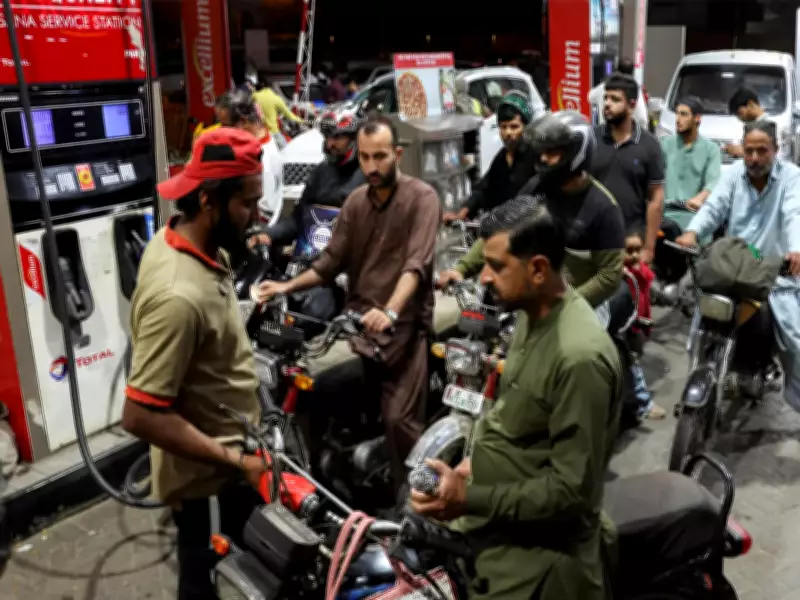
Pakistan's Economic Crisis Deepens Amid Middle East Conflict
As the war in the Middle East continues to escalate, tensions are mounting for the South Asian nation of Pakistan, which is now grappling with a severe economic crisis. The conflict has led Iran to disrupt fuel shipments through the Strait of Hormuz, Pakistan's main oil supply route, causing widespread repercussions across the country.
Oil Supply Disruption and Soaring Costs
Pakistan relies heavily on Saudi Arabia and the United Arab Emirates for over 85% of its crude oil, with most of it passing through the Strait of Hormuz. Recent attacks on at least 16 ships, including tankers, have significantly slowed maritime traffic, leaving numerous vessels stranded at Karachi, the nation's key commercial port. This supply disruption has not only pushed fuel prices higher globally but has hit Pakistan particularly hard.
Finance Minister Muhammad Aurangzeb had earlier predicted that the country's monthly oil import bill could soar to a staggering $600 million as prices continue to jump. The government responded by increasing fuel prices by 20% on March 6 to curb hoarding, marking one of the steepest rises worldwide since the start of the US-Israeli war in Iran.

Impact on Agriculture and Urban Life
The rising oil costs are severely affecting farmers preparing for the spring harvest. Aamer Hayat Bhandara, a farmer from Punjab's Pakpattan district, explained, "The use of tractors and other agricultural machinery is unavoidable at most stages of cultivation and harvesting, and these largely run on diesel." Agriculture accounts for over 23% of Pakistan's gross domestic product and employs 37% of the labor force, making the sector especially vulnerable to price shocks.
In urban areas, the crisis is equally palpable. Diesel-powered rickshaws, taxis, and commuter vehicles have become more expensive to operate. Muhammad Roshan, a rickshaw driver in Rawalpindi, voiced frustration, "They could have gotten oil from Russia. Why haven't they explored that opportunity?" The price hike has hit households hard, particularly in a country where nearly half the population lives in poverty, according to World Bank estimates.
Broader Economic and Social Consequences
Economists warn of wider consequences if the crisis persists. Kaiser Bengali, a Pakistani economist, stated, "Pakistan is already bankrupt and surviving loan by loan," referring to IMF assistance. "Any prolonged disruption could topple its economy." Retail activity ahead of Eid has slowed, with many customers prioritizing essentials. Shabbir Ahmed, a clothing trader in Karachi, noted, "There is no such rush in the markets."
With energy supplies constrained and prices rising, Pakistan's rural and urban populations are bracing for a challenging period ahead, where livelihoods, education, and traditional festivities are all being affected.
Mitigation Efforts and Diplomatic Challenges
To deal with the supply shock, some schools are shifting to online learning, though many children lack access to laptops, tablets, or reliable internet. Families are canceling trips for Eid al-Fitr, typically a time of celebration at the end of Ramadan. Ali Akbar, a real estate worker in Islamabad, said he is postponing a homecoming trip and considering moving his children to a school within walking distance. "Monthly transportation costs for them have already risen to $48 from $36 over the past week," he explained.
Pakistan has attempted to mitigate shortages through domestic measures, including promoting solar power for electricity production and reducing official trips and the workweek. Authorities have also sought Saudi Arabia's help to supply oil via Red Sea ports. However, economists caution that cutting workdays may hurt daily-wage earners and middle-class families.
As its economy suffers, the country is treading carefully on the diplomatic front. The government has worked to bolster relations with the Trump administration while avoiding criticism of the United States' strikes on Iran. To ease the energy crunch, Pakistan has asked Saudi Arabia to route oil shipments through its Red Sea ports, highlighting the delicate balance between economic survival and geopolitical pressures.






