

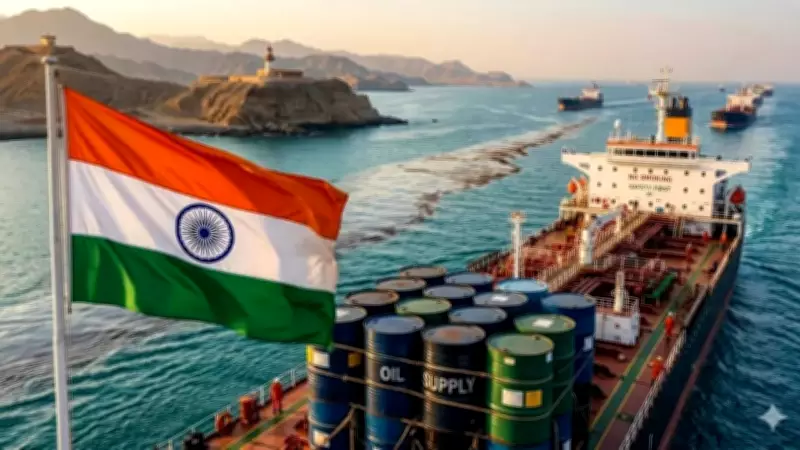
Middle East Tensions Escalate, Putting India's Oil Supply at Risk
The recent military strikes by Israel and the United States on Iran, followed by Iran's retaliatory actions, have significantly heightened geopolitical tensions in the Middle East. This escalation carries profound implications for India, a nation that imports approximately 90% of its crude oil. The volatile situation in the Persian Gulf region now directly threatens India's critical oil supply chains, raising concerns about economic stability and energy security.
The Strategic Importance of the Strait of Hormuz
The Strait of Hormuz stands as a vital maritime chokepoint in the Middle East, facilitating the transit of an estimated 20-25% of global crude oil supply. This narrow sea passage, located at the entrance of the Persian Gulf, spans about 100 miles with its narrowest stretch measuring 21 miles wide. It is bordered by Iran to the north and the United Arab Emirates and Oman to the south. Due to its shallow depth, ships navigating this corridor are particularly vulnerable to hazards such as naval mines, amplifying risks during conflicts.
According to data from analytics firm Vortexa, cited in a Reuters report, the Strait of Hormuz handled average daily flows exceeding 20 million barrels of crude oil, condensates, and refined petroleum products last year. Many OPEC members, including Saudi Arabia, Iran, the UAE, Kuwait, and Iraq, rely heavily on this passage to supply crude oil to Asian markets. Kpler, a global real-time data and analytics provider, notes that India's recent shift back toward Middle Eastern crude has increased its near-term exposure to risks associated with the Strait of Hormuz.

India's Growing Exposure to Hormuz-Linked Risks
Kpler's vessel tracking data reveals that approximately 2.5–2.7 million barrels per day of India's crude imports transit the Strait of Hormuz, accounting for roughly 50% of the country's total crude imports. These supplies are primarily sourced from Iraq, Saudi Arabia, the UAE, and Kuwait. Sumit Ritolia, Lead Research Analyst for Refining and Modelling at Kpler, explains, "Over the past two to three months, India's dependence on Middle Eastern barrels has increased as refiners have pivoted away from a portion of Russian volumes. As a result, the relative weight of Gulf-origin crude in India's import basket has risen, increasing short-term sensitivity to any disruption in Hormuz transit."
Ritolia adds that while escalation could lead to higher prices, freight, and insurance costs, the probability of a prolonged full blockade remains low. However, temporary disruptions cannot be ruled out, posing significant challenges.
Potential Closure of the Strait of Hormuz
Recent reports indicate that vessels transiting the Strait of Hormuz have been receiving radio messages stating, "no ship is allowed to pass the Strait of Hormuz," as noted by an official with the European Union's naval mission Operation Aspides. While Iran has not officially confirmed any order to close the strait, these warnings, reportedly delivered via VHF radio, suggest heightened risks. The United States has already advised its commercial ships to avoid the Gulf region.
Experts believe that Iran may not be able to fully close the Strait of Hormuz, as doing so would severely impact its own crude oil exports. Nevertheless, perceived dangers in the area could deter tankers and ships from attempting passage. Ritolia emphasizes, "Temporary slowdowns, rerouting, or heightened maritime security checks are more plausible scenarios. A sustained blockade would significantly impact regional producers' own export revenues, creating strong economic disincentives. Therefore, volatility risk is elevated, but structural and prolonged supply loss remains lower probability."
Impact on Crude Prices and India's Economy
In the current escalation scenario, the initial impact on India is likely to be price-driven rather than volume-driven. Ritolia points out that a geopolitical risk premium would lift Brent prices, alongside increases in freight rates and war-risk insurance costs. This means that even without physical shortages, landed crude costs for Indian refiners would rise, leading to higher crude oil import bills and potential macroeconomic pressures.

From a domestic pricing standpoint, Kpler does not anticipate an immediate increase in retail fuel prices by oil marketing companies in the near term. Ritolia notes, "Although fuel pricing is deregulated, adjustments typically follow sustained crude strength rather than short-lived volatility. The government is expected to closely monitor developments to manage inflationary risks."
Diversification and Strategic Reserves as Buffers
India's strategy of diversifying its crude oil procurement sources serves as a cushion amid geopolitical uncertainty. The country currently imports crude from over 40 countries, allowing flexibility in adjusting the mix based on pricing and availability. Kpler highlights that India has diversified its sourcing across Russia, the US, West Africa, and Latin America. However, Ritolia cautions that barrels from the Atlantic Basin involve substantially longer voyage durations—typically 25–45 days compared to roughly 5–7 days from the Gulf. "While diversification provides supply continuity, it comes with higher freight exposure and longer supply chains. Middle Eastern crude therefore retains a clear logistical advantage and remains structurally important to India's supply stability," he says.
In a contingency scenario, India's strategic petroleum reserves and operational crude stocks held by refiners provide additional resilience. These inventories can bridge short-term gaps, and depots, ports, and refining systems maintain stocks of key petroleum products like diesel, gasoline, ATF, and LPG for strategic management during disruptions.
Russian Crude as a Potential Alternative
India has been reducing its imports of Russian crude in recent months, partly due to sanctions imposed by the Donald Trump administration on major Russian oil firms like Lukoil and Rosneft. However, if the Strait of Hormuz faces closure, Kpler tracking indicates continued availability of Russian cargoes in the Indian Ocean and Arabian Sea region, including volumes in floating storage. Ritolia explains, "Should Middle Eastern inflows tighten, Indian refiners could pivot back toward Russian grades relatively quickly. The presence of 'oil on water' in close proximity to Indian ports provides near-term supply elasticity and commercial flexibility. This optionality serves as an important buffer in the event of temporary Gulf disruptions."
In conclusion, while the principal near-term vulnerability for India is price volatility and macroeconomic impact rather than structural supply insecurity, the escalating Middle East tensions underscore the critical need for vigilant energy security strategies. As Ritolia summarizes, "The principal near-term vulnerability is therefore price volatility and macro impact, not structural supply insecurity."





