

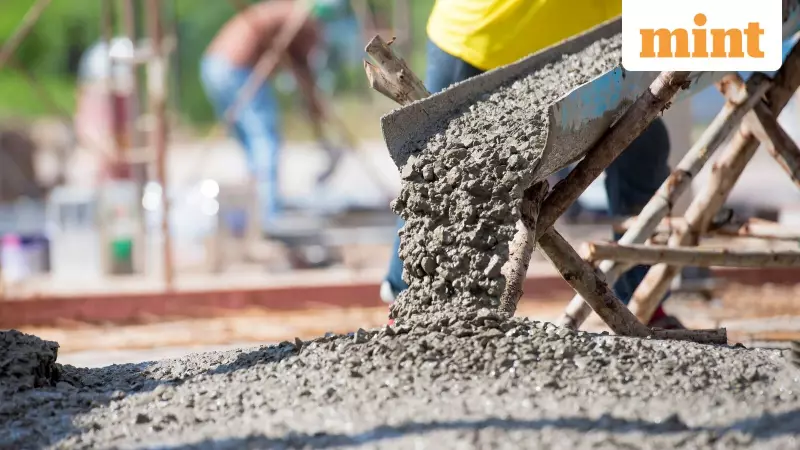
China's dramatic construction slowdown has created an unexpected plateau in global cement production, presenting what could be a significant climate dividend for the planet. While this development appears concerning for economic growth metrics, environmental analysts suggest it may represent a turning point for one of the world's most carbon-intensive industries.
The Cement Conundrum: Ubiquitous Yet Overlooked
When considering the most crucial commodities for modern civilization, concrete rarely receives the attention afforded to oil, gas, or precious metals. Yet this ubiquitous material represents humanity's second most-consumed substance after water, with annual global usage ranging between 25 and 30 billion tonnes. This staggering volume exceeds coal extraction by approximately three times, highlighting concrete's fundamental role in global development.
Cement serves as the essential binding agent within concrete, and its production carries substantial environmental consequences. The industry contributes roughly 8% of annual global carbon emissions, establishing cement as a major player in climate change discussions. Each manufactured tonne releases approximately 0.8 tonnes of carbon dioxide into the atmosphere—a concerning figure when multiplied by the industry's massive scale.

China's Cement Dominance and Decline
For three decades, China has driven global cement markets, currently accounting for nearly half of worldwide production. The country's construction boom reached extraordinary intensity, with per capita consumption peaking at about 1.8 tonnes annually in 2014—more than seven times the United States' consumption rate during the same period.
Recent data reveals a dramatic reversal in this trend. Since 2020, China's cement output has declined by almost 30%, with credit-rating agency CSCI Pengyuan projecting a sixth consecutive year of reduction in 2026. Prices have plummeted to decade-low levels, while factories operate with more than double their required capacity. December's newly-started commercial building floor area—a key leading indicator—reached its lowest point since 2003, despite China producing nearly twice as much cement as it did during that earlier period.
The Global Cement Plateau
Current trends suggest humanity may never return to the peak 4.4 billion tonnes of cement produced globally in 2021. This plateau persists despite continued industrialization and urbanization in India, Southeast Asia, and Africa. The phenomenon reflects cement's unique consumption pattern compared to other commodities.
Unlike energy, copper, or plastics—whose consumption typically grows with rising incomes before stabilizing at developed-economy levels—cement demand drops precipitously once countries complete their industrialization phase. This pattern explains why per-capita cement emissions in the United Kingdom resemble those in low-income nations like Burkina Faso and Syria, while Albania and Cambodia maintain consumption rates approximately triple those of the United States.
China's Future Cement Trajectory
China's current per capita cement consumption remains elevated at approximately 1.2 tonnes annually—four times the global average and surpassed only by Saudi Arabia among major economies. While unlikely to decline rapidly to levels seen in high-income nations, even modest reductions would create substantial global impact.
Should China's annual per-capita consumption decline slow from the recent 6% average to 4% through 2030, the country would still maintain consumption rates nearly triple those of seismically-active Japan. This reduction would translate to approximately 350 million fewer tonnes of cement production—a monumental decrease that no other nation could realistically offset.
Emerging markets like Egypt, Indonesia, Turkey, and Vietnam are projected to increase production by just five to ten million tonnes each, while India—the most significant growth market—might add 40 to 50 million tonnes. These increases pale in comparison to China's potential reductions.

Climate Implications and Technological Limitations
The cement production plateau arrives as welcome news for climate advocates, given the industry's limited progress in emissions reduction. Technological solutions have proven disappointingly incremental, with methods like adding volcanic ash or industrial waste materials to concrete mixtures reducing emissions by only 5-10%.
Carbon capture and storage technologies remain largely theoretical for cement production, with minimal real-world implementation. Furthermore, the nations most likely to adopt such measures tend to be wealthy countries where concrete consumption is already declining, limiting their potential global impact.
This reality makes consumption reduction the most viable path toward cleaning up the cement industry. Fortunately, economic development patterns suggest this reduction may occur naturally as countries progress through industrialization phases. China's construction slowdown, while challenging economically, may ultimately represent a crucial turning point for global emissions from this hard-to-abate sector.
The cement industry's most productive years appear to be receding into history, with its future already showing signs of structural transformation. As global production plateaus, climate advocates can find cautious optimism in this unexpected alignment of economic development and environmental necessity.





