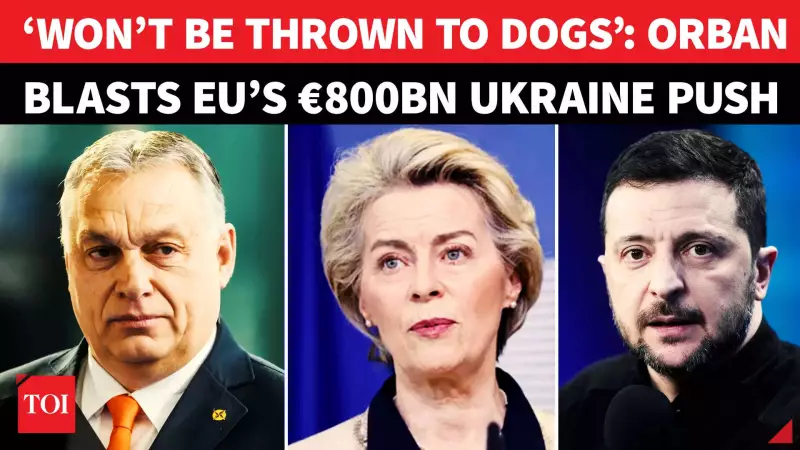
Hungarian Prime Minister Viktor Orbán has launched a fierce critique against the European Union's substantial financial commitment to Ukraine, cautioning that such actions risk pulling Hungary into a broader conflict. Speaking from Budapest on January 7, 2026, Orban explicitly rejected the proposed $800 billion support package for Kyiv, framing it as a direct threat to continental stability.
Orban's Stern Warning on European Security
The Prime Minister made his position unequivocally clear during his address. He argued that channelling billions of euros to Ukraine does not serve Europe's long-term peace interests. Instead, Orban believes these funds endanger the stability that the European bloc has worked to maintain. His core message was a vow to protect Hungarian sovereignty, stating he would not allow the nation's capital or its security to be sacrificed for foreign wars. He used strong language, asserting these assets would not be "thrown to the dogs" for external conflicts.
Rejection of the EU's Financial Package
At the heart of Orban's criticism is the colossal $800 billion aid bill proposed for Ukraine. The Hungarian leader sees this financial move as an escalation that indirectly involves all EU member states in the ongoing war. His rejection is rooted in a long-standing policy of maintaining closer ties with Russia compared to other EU nations, emphasising energy and economic links. Orban's government has consistently called for a ceasefire and diplomatic negotiations rather than military and financial support for Kyiv.

Broader Implications for EU Unity
This latest outburst from Budapest highlights the deepening rift within the European Union regarding the response to the war. Orban's stance puts him at odds with the majority of EU leaders who have championed robust support for Ukraine. The disagreement goes beyond policy, touching on fundamental questions of European solidarity and strategic autonomy. Analysts suggest that Hungary's position could complicate future EU decision-making processes, especially those requiring unanimity on foreign policy and budgetary matters.
Orban's warnings reflect a broader narrative of caution against actions that could provoke a wider war. He positions Hungary as a nation seeking peace and stability, even if it means diverging from the common EU path. The Prime Minister's statements are likely to resonate with his domestic base and further solidify his image as a leader willing to challenge Brussels for what he perceives as Hungary's national interest.