

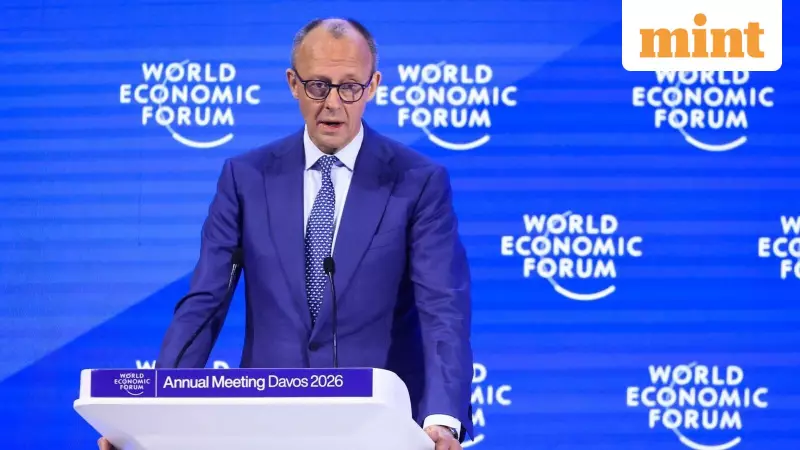
German Chancellor Merz Advocates for European Unity Amid Global Power Shifts
German Chancellor Friedrich Merz has issued a compelling call for Europe to bolster its unity and economic competitiveness in response to a disruptive wave of "great-power politics" that has strained transatlantic relationships. Speaking at the World Economic Forum in Davos, Merz highlighted the critical need for a cohesive European stance to navigate these turbulent geopolitical waters.
Merz's Response to Trump's Greenland Gambit
Merz expressed cautious optimism regarding US President Donald Trump's recent declaration that he would not resort to military force to acquire Greenland, a semi-autonomous Danish territory. This statement came after Trump abruptly retracted his threat to impose new tariffs on several European nations that had opposed his ambitions for Greenland. The sudden de-escalation provided a temporary respite at the gathering of global leaders, though underlying tensions persist.
In his Thursday address, Merz reflected on the fragility of the international order, stating, "The international order of the past three decades — anchored in international law — has always been imperfect. Today, its very foundations have been shaken." He underscored the profound impact of recent events on global stability and the necessity for a recalibrated approach to international relations.

Diverging European Strategies and Trade Implications
Merz advocated for a more measured response to Trump's tariff threats, contrasting with French President Emmanuel Macron's suggestion to utilize the European Union's anti-coercion instrument. Acknowledging Germany's heavy reliance on exports, Merz noted that this economic dependency makes the nation less inclined to deploy the bloc's most aggressive trade countermeasures. He warned, "New tariffs would undermine the foundations of transatlantic relations," while affirming that Europe's reaction should be "united, calm, measured, and firm."
The European Union has suspended its trade agreement with the United States in the wake of Trump's threats, an accord that many within the bloc had already perceived as inequitable. This agreement, finalized last summer, required the EU to eliminate nearly all tariffs on American goods while accepting a 15% duty on most exports to the US and a 50% levy on steel and aluminum. The suspension marks a significant setback in transatlantic economic cooperation.
Uncertainty Surrounding Greenland and Diplomatic Standoffs
Details of Trump's proposed "framework" for Greenland remain ambiguous, adding to the uncertainty. Denmark has firmly rejected any negotiations concerning the cession of the semi-autonomous island, with Danish Prime Minister Mette Frederiksen asserting, "We cannot negotiate our sovereignty." She emphasized Denmark's willingness to engage in discussions on security, investments, and economic matters, but drew a clear line on territorial integrity.
NATO Secretary General Mark Rutte revealed that his discussions with Trump at the forum focused on Arctic security in a practical context, specifically addressing strategies to prevent Russia and China from gaining access to Greenland. This highlights the broader strategic implications of the territory in global power dynamics.
Merz's Vision for European Competitiveness and Reforms
Merz passionately argued for Europe to enhance its economic competitiveness and foster a more favorable environment for domestic businesses. He announced plans to meet with Italian Prime Minister Giorgia Meloni to outline priorities, including proposing an emergency brake for bureaucratic processes and modernizing the EU's budget. Merz stressed that Europe's geopolitical influence is intrinsically linked to its economic vitality, stating, "I will insist that rapid progress be made, including on the capital markets union. We cannot allow our European champions to continue being dependent on the US capital markets."
Furthermore, Merz emphasized the importance of strategically expanding the EU's trade partnerships worldwide. He criticized the European Parliament's decision to subject the new Mercosur trade agreement to judicial review, asserting his determination to see the deal proceed despite legislative hurdles.

Broader Implications and the Path Forward
The controversy over Greenland and the associated tariff threats have plunged transatlantic relations to a historic low. EU leaders are scheduled to convene in Brussels to address this deterioration and chart a course for recovery. Merz concluded by advocating for a paradigm shift in how democracies interact, urging that they view each other as allies, partners, and trusted friends rather than subordinates. His call to action underscores a pivotal moment for Europe as it seeks to assert its independence and strength in an increasingly fragmented global landscape.





