

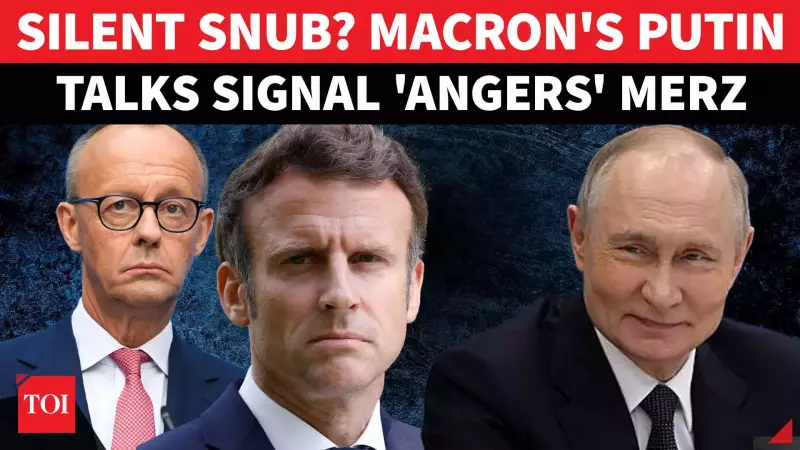
Europe's much-touted unity faces a severe test as a significant diplomatic rift emerges between its two leading powers, France and Germany. A recent report has revealed that French President Emmanuel Macron did not inform German Chancellor Friedrich Merz about a crucial proposal to re-engage with Russian President Vladimir Putin.
A Stunning Diplomatic Snub
The revelation, detailed in a report by the German newspaper Die Welt on December 29, 2025, has sent shockwaves through European capitals. According to the report, Chancellor Merz was kept in the dark about President Macron's initiative towards Moscow. This lack of prior consultation is seen as a major breach of trust between the traditional engines of the European Union.
Berlin's official response was notably terse and cold. A German government spokesperson stated that they had merely "taken note" of the French proposal. This muted, almost dismissive reaction is a stark departure from the traditionally coordinated Franco-German stance and has fuelled intense speculation about the depth of the disagreement.

Partnership Under Strain
Political analysts are warning that the once-strong Merz-Macron partnership, which was expected to provide steady leadership for a continent grappling with war and economic turmoil, is now visibly faltering. The disagreements, which many believe extend beyond this single incident, are becoming increasingly difficult to conceal from the public eye.
The timing of this rift could not be more critical. As the war continues to rage in Ukraine and delicate diplomatic efforts hang in the balance, the apparent misalignment between Paris and Berlin raises profound questions about Europe's collective strategy. The core issue now is whether Europe's two most powerful leaders are still working in concert or are drifting dangerously apart on one of the most significant security challenges of our time.
Implications for European Security
This public exposure of discord at the highest level threatens to undermine the European Union's unified front against Russian aggression. A divided Franco-German axis weakens the bloc's negotiating power and sends confusing signals to both allies in Kyiv and adversaries in Moscow. The incident highlights the fragile nature of European solidarity when faced with prolonged geopolitical pressure.
The coming days will be crucial in determining whether this is a temporary diplomatic friction or a sign of a deeper, more fundamental split in European foreign policy. The world will be watching to see if Merz and Macron can bridge this gap or if the cracks in Europe's unity will widen further.






