

Hungary's Prime Minister Issues Stark Warning Over Ukraine Conflict
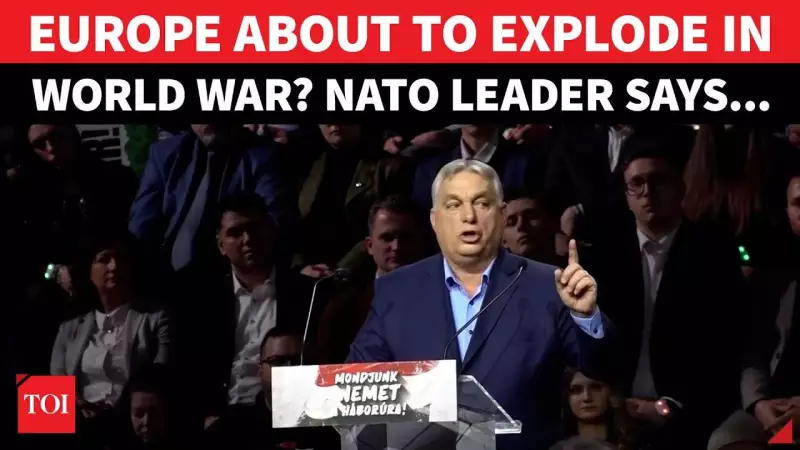
Hungarian Prime Minister Viktor Orban delivered a forceful speech on Saturday, warning that his country faces daily pressure to enter the Ukraine war. Speaking at an anti-war rally in Miskolc, Orban declared that Hungary must resist being dragged into the conflict.
'War Knocks on Our Door Every Day'
"Hungary is being forced and dragged into a war - it is not a theoretical possibility," Orban stated during the 'Digital Civic Circle' event. He painted a vivid picture of the threat, saying, "This is what knocks on the door every day, and I have to keep that door shut with all my strength."
The Prime Minister emphasized that avoiding war represents the most critical priority for Hungary's future. "Being drawn into a war is a daily danger for Hungary, so the first prerequisite for any grand future plan is to stay out of the war," he stressed.

Orban Accuses EU of Transforming Into 'War Council'
Orban directed sharp criticism toward the European Union, accusing the bloc of fundamentally changing its character. He claimed the EU has shifted from a political body to what he called a 'war council.' This transformation, according to Orban, represents a dangerous departure from the union's original purpose.
The timing of Orban's remarks carries particular significance as Hungary approaches parliamentary elections in April 2026. His strong anti-war stance appears calculated to resonate with voters who may share concerns about entanglement in foreign conflicts.
Hungary's Delicate Position in European Politics
Hungary maintains a unique position within the European Union regarding the Ukraine conflict. While most EU members strongly support Ukraine against Russian aggression, Orban's government has pursued a more cautious approach. This has created tensions with other European leaders who advocate for stronger collective action.
Orban's speech reflects his government's determination to maintain Hungary's sovereignty in foreign policy decisions. He presented staying out of the war not as isolationism but as essential for national security and future planning.
The Prime Minister's warnings come amid ongoing debates within Europe about how to respond to Russia's actions in Ukraine. His characterization of the EU as a 'war council' represents one of his strongest criticisms yet of the bloc's direction under current leadership.
As elections approach, Orban's anti-war message likely aims to solidify his political base while distinguishing Hungary's position from mainstream European consensus on Ukraine. The speech underscores the complex geopolitical calculations facing smaller EU nations during times of international conflict.






