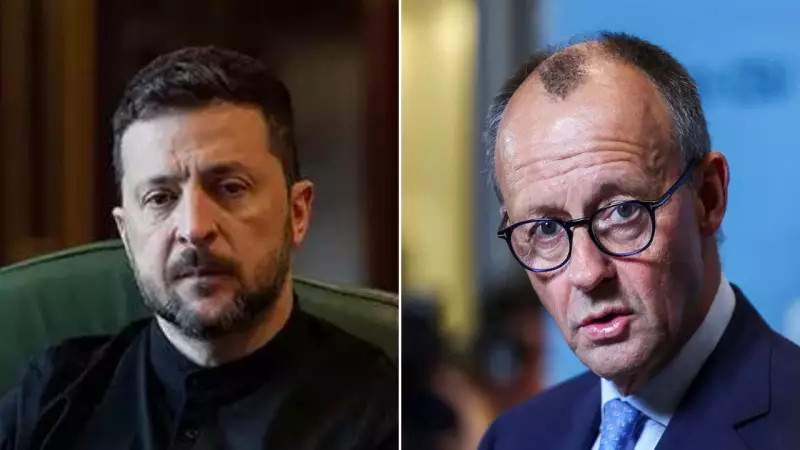
German Chancellor Friedrich Merz has joined growing voices within his Christian Democratic Union (CDU) and its Bavarian counterpart, the Christian Social Union (CSU), demanding a reduction in the flow of young Ukrainian men entering Germany. In a significant phone conversation last Thursday, Merz directly appealed to Ukrainian President Volodymyr Zelenskyy to ensure that young Ukrainians, in particular, do not continue arriving in Germany in increasing numbers.
The Political Pressure Builds
Markus Soeder, Bavarian Prime Minister and CSU leader, emerged as the first prominent German politician to voice these concerns. During an interview with German tabloid Bild, Soeder urged both the EU and German government to exert pressure on Kyiv to effectively control and substantially reduce the influx of young men escaping Russia's ongoing war of aggression toward Germany.
The CDU's Secretary General, Carsten Linnemann, quickly echoed similar sentiments, creating a unified front within the opposition parties. This political movement gained momentum after Kyiv's late August decision to permit men aged 18 to 22 to leave the country, despite this age group not being subject to military draft in Ukraine.

The statistical evidence reveals a dramatic surge, with German Interior Ministry data showing weekly arrivals in this demographic jumping from merely 19 in mid-August to between 1400 and 1800 by late October. Germany currently hosts more than 1.2 million Ukrainian refugees overall, creating significant pressure on the nation's resources.
Political Divisions and Humanitarian Concerns
The ruling Social Democrats (SPD) have maintained a cautious stance in this heated debate. Ralf Stegner, an SPD parliament member, expressed difficulty in demanding young Ukrainians serve as soldiers for their country. He emphasized that the primary focus should remain on ending the war promptly rather than concentrating on migration issues, which often serve as background for such political initiatives.
Stefan Meister from the German Council on Foreign Relations (DGAP) in Berlin provided insight into the government's motivations. He identified Merz's appeal as partly driven by the German government's broader objective to restrict migration to Germany. The Chancellor faces dual pressures: concern about Ukraine losing its necessary young population and the need to fulfill election promises regarding immigration control.
Meister noted that Germany has absorbed more than one million Ukrainians, a number that places noticeable strain on the German system. The political scientist also accused the chancellor of engaging in a form of populism, noting that the far-right Alternative for Germany (AfD) party is exerting significant pressure on the CDU through this ongoing debate.
Policy Changes and Ukrainian Perspectives
Recent policy adjustments appear to support Meister's analysis. Germany's reformed basic income benefit scheme, interpreted by several observers as a message to potential AfD voters, will reduce benefits for Ukrainian refugees arriving after April 1, 2025. This change aligns their support levels with those of regular asylum seekers, resulting in approximately €120 less per month.
Winfried Schneider-Deters, a political scientist and journalist living between Ukraine and Germany, supported Merz's position, calling it grotesque that the German chancellor must remind the Ukrainian president that young Ukrainians are needed in their homeland, particularly as soldiers before reconstruction efforts can properly begin.
However, Iryna Schulikina, executive director of the Ukrainian NGO Vitsche in Berlin, offered a contrasting perspective. She emphasized that while Ukraine needs people, it equally requires weapons and called for European countries, including Germany, to cease financing Russia's war through continued oil and gas purchases.
Schulikina defended the young Ukrainians, noting that Germans aged 18 to 22 typically just finished school, often remain on parental health insurance, and receive child benefits. She questioned why young Ukrainians should suddenly be treated as adults rather than adolescents simply because of their nationality, especially considering their lives have been marked by 11 years of conflict, including four years of full-scale Russian invasion.

Regarding return prospects, Schulikina dismissed claims that Ukrainians plan to stay abroad permanently as manipulation, asserting that many are either returning, planning to return, or studying to become useful to their country's future.
Despite these assurances, research data suggests different intentions. Studies indicate that 59% of those who fled during the war's initial months and 69% of later arrivals express no interest in returning to Ukraine. While exact return numbers remain unavailable, estimates suggest between 300,000 and 400,000 Ukrainians who came to Germany since 2022 have either returned home or moved to other countries.