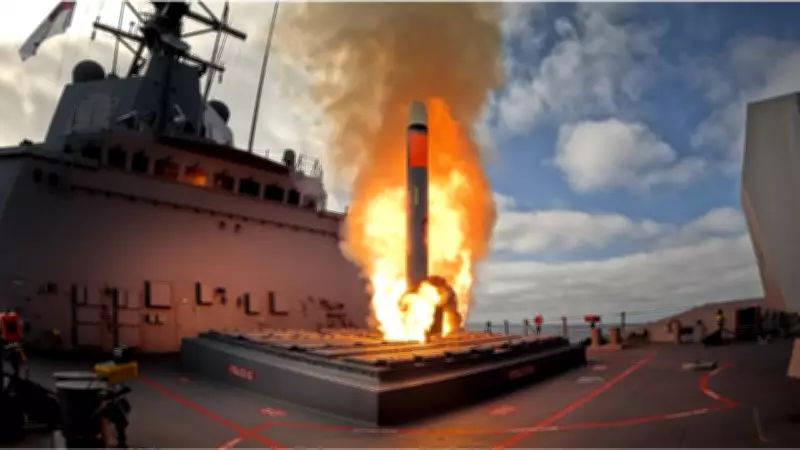
US Tomahawk Missile Usage in Iran Conflict Exceeds Replenishment Rates
The United States military has launched more than 850 Tomahawk cruise missiles during the initial four weeks of its ongoing conflict with Iran, according to reports from The Washington Post. This rapid deployment has ignited significant concerns within the Pentagon regarding the depletion of these precision-guided weapons, with officials warning that stockpiles in the Middle East are now alarmingly low.
Internal Pentagon Discussions on Missile Shortages
Sources familiar with the situation revealed to The Post that the high consumption rate has prompted urgent internal debates about replenishing inventories and potentially reallocating missiles from other strategic regions, including the Indo-Pacific. One official described remaining supplies as critically insufficient, while another cautioned that the military might be approaching a "Winchester" status—a term denoting ammunition exhaustion.
In response, Pentagon spokesperson Sean Parnell asserted that the US armed forces possess all necessary resources to execute missions as directed by the President, downplaying fears of shortages. However, the disparity between operational demands and production capabilities underscores a growing logistical challenge.

Strategic Importance of Tomahawk Missiles
Tomahawk missiles have become indispensable in US operations against Iran due to their ability to strike targets from distances exceeding 1,000 miles without endangering pilots in heavily defended airspace. Typically launched from Navy warships and submarines, these weapons facilitate long-range precision attacks.
Analysts estimate that prior to the conflict, the US Navy maintained an inventory of approximately 3,000 to 4,500 Tomahawks. The current usage rate suggests a substantial portion of this stockpile has already been expended. With annual production limited to a few hundred missiles, replenishing these reserves could require several years, exacerbating supply constraints.
Unique Capabilities of the Tomahawk Missile
Often referred to as a "terrain-hugging flying robot," the Tomahawk is a long-range, unmanned cruise missile engineered to fly at extremely low altitudes—as low as 30–90 metres—to evade radar detection. Its advanced guidance systems include GPS, inertial navigation, and terrain contour matching (TERCOM), ensuring accuracy within about 5 metres over ranges up to 1,500 miles.
Powered by a turbofan engine that reduces heat signature and enhances stealth, modern variants like the Block IV and Block V offer additional functionalities. These missiles can be retargeted mid-flight, loiter over battlefields, and transmit real-time imagery to operators for damage assessment, according to manufacturer Raytheon.
Evolution and Upgrades: From Block IV to Block V
The Tomahawk has undergone significant enhancements in recent versions:
- Block IV (TACTOM): Capable of changing targets during flight and loitering before engagement.
- Block V: Features upgraded navigation and communication systems.
- Block Va: Specifically designed to strike moving maritime targets.
- Block Vb: Equipped with advanced warheads for diverse land-based objectives.
The US Navy initiated upgrades to older missiles in 2020, extending their service life by up to 15 years to mitigate production delays.
Cost, Production, and Supply Challenges
Each Tomahawk missile carries a price tag of up to $3.6 million and may take up to two years to manufacture, as per Navy documents cited by The Washington Post. Annual production capacity is estimated at around 600 units, a rate insufficient to meet current wartime demands.
Despite being a cornerstone of US military operations since the Gulf War, Tomahawks are produced in limited batches. For instance, only 57 were included in last year's defense budget. Over time, the US has purchased nearly 9,000 Tomahawks, though many older models have since been retired.

Operational Strain and Resupply Efforts
The intense usage has compelled the US Navy to conduct at-sea resupply operations for certain warships, a capability developed in recent years to maintain combat readiness. Concurrently, the military has fired over 1,000 air-defense interceptors to counter Iranian strikes, further straining munitions stockpiles.
Strategic Implications and Future Steps
The rapid depletion of Tomahawks has raised broader concerns in Washington about preparedness for potential future conflicts, particularly in regions like the Western Pacific. While the administration maintains that current supplies are adequate, it has engaged defense contractors, including Raytheon, to accelerate production.
President Donald Trump announced that companies had agreed to "quadruple production of the 'Exquisite Class' weaponry." As the conflict persists, officials and lawmakers are balancing immediate operational needs against long-term stockpile sustainability, with funding requests and production timelines expected to be critical in the coming months.