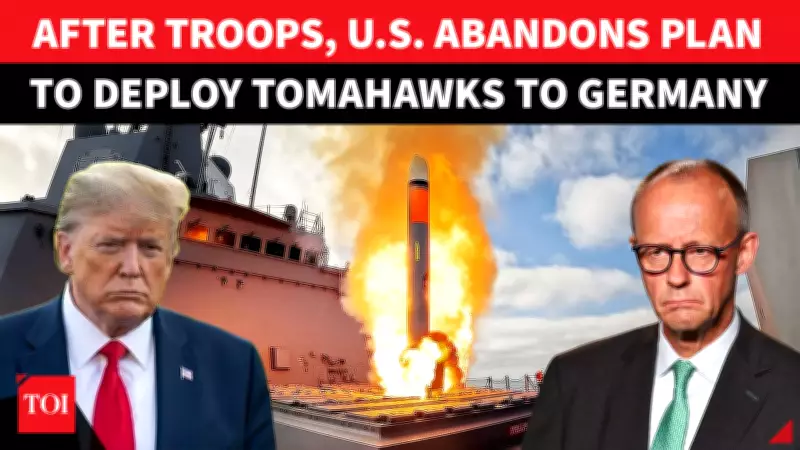
The United States Department of Defence has reportedly decided to abandon a long-planned deployment of long-range strike weapons, including Tomahawk missile systems, to Germany, according to sources. This dramatic shift in NATO's defence plans has sparked unease among European allies, raising questions about the future of the alliance under former President Donald Trump.
Background of the Deployment
The Tomahawk missile deployment was part of a broader strategy to bolster NATO's eastern flank against potential Russian aggression. The plan involved stationing advanced long-range strike capabilities in Germany, a key NATO member, to enhance deterrence. However, the US withdrawal of troops from Germany in recent years had already strained relations, and this latest decision signals a further erosion of commitment.
Reasons for the Cancellation
While official reasons remain unclear, analysts point to several factors. The Trump administration has long criticized NATO allies for not meeting defence spending targets, and this move may be intended to pressure Germany and other European nations to increase their military contributions. Additionally, the cancellation aligns with Trump's 'America First' policy, which prioritizes US interests over multilateral commitments.

Some experts speculate that the decision could be linked to ongoing negotiations with Russia over arms control. By shelving the Tomahawk deployment, the US might be seeking to de-escalate tensions with Moscow, especially amid the conflict in Ukraine. However, this has left European allies feeling exposed and uncertain about US security guarantees.
Reactions from Germany and NATO
German officials have expressed deep disappointment, calling the move a blow to transatlantic unity. The German Defence Ministry stated that it was not consulted on the decision and warned that it could undermine NATO's collective defence posture. Other NATO members have echoed these concerns, with some questioning whether the US remains a reliable partner.
NATO Secretary General Jens Stoltenberg urged the US to reconsider, emphasizing that the alliance's strength depends on shared commitments. However, Trump's administration has shown little inclination to reverse course, fueling speculation that a formal US exit from NATO could be on the horizon.
Implications for European Security
The cancellation of the Tomahawk deployment leaves a significant gap in NATO's deterrence capabilities. European nations may now need to accelerate their own defence investments, including developing indigenous long-range strike systems. This could lead to a more fragmented security landscape, with countries like France and Germany taking on greater responsibility.
Moreover, the move could embolden Russia, which has long opposed NATO's expansion near its borders. Moscow has welcomed the US decision, with Kremlin spokesman Dmitry Peskov calling it a 'positive step' that could reduce tensions. However, Western analysts warn that it might also encourage further Russian aggression in Eastern Europe.
Trump's NATO Exit: A Real Possibility?
The cancellation has reignited debates about Trump's commitment to NATO. During his presidency, Trump repeatedly threatened to withdraw from the alliance, demanding that allies pay more for their defence. While no official exit has been confirmed, this latest action suggests that the US is willing to unilaterally alter its military posture, undermining the alliance's core principles.
Critics argue that abandoning the Tomahawk deployment weakens NATO's credibility and could lead to a domino effect, with other allies reconsidering their own commitments. Supporters of Trump, however, contend that the US should not bear the burden of European security alone and that allies must step up.
As the situation develops, European leaders are scrambling to assess the implications and explore alternative security arrangements. The future of NATO hangs in the balance, with the transatlantic partnership facing its most serious test in decades.