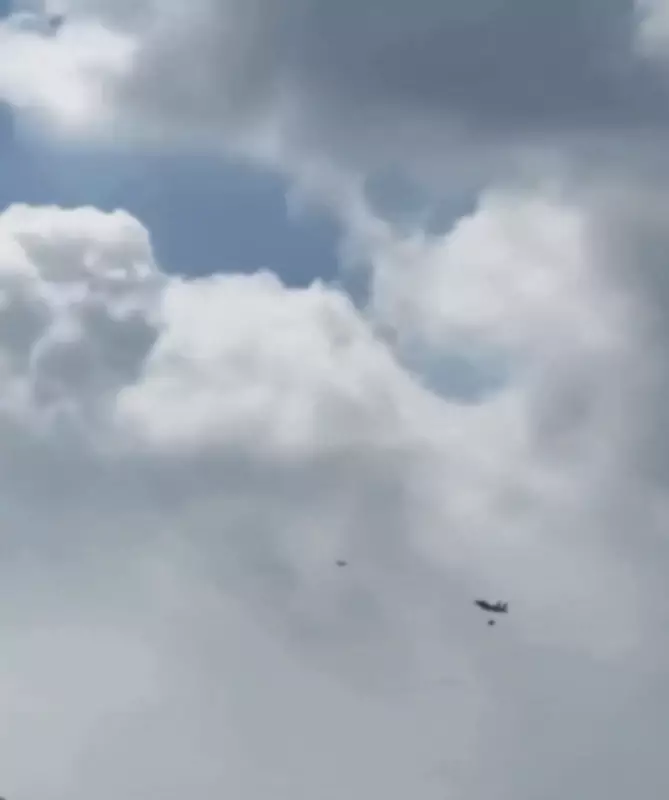
Viral Footage Captures US Fighter Jet's Failed Drone Interception Over Iraq
A compelling video that has gone viral across social media platforms appears to depict a high-stakes aerial engagement over Iraqi territory. The footage, widely circulated on X and other networks, shows a United States Air Force F-15 fighter jet in hot pursuit of what is believed to be an Iranian-manufactured Shahed-136 unmanned aerial vehicle (UAV).
Details of the Aerial Chase Over Cloudy Skies
The video, captured from an undisclosed source, portrays the F-15 closing in on the drone against a backdrop of cloudy skies. Observers noted that the pilot attempted to maneuver the advanced fighter aircraft into a favorable intercept position directly in front of the UAV. However, in a critical misstep, the jet overshot its target, allowing the drone to evade capture. Despite subsequent efforts by the pilot to reacquire and engage, the Shahed drone ultimately escaped, disappearing from view.
Accounts sharing the video have made striking claims about the cost disparity involved in this encounter. They assert that the $1 million American F-15 "failed to intercept" at least two relatively inexpensive $20,000 Shahed-136 drones. This has sparked discussions about the effectiveness of high-value military assets against low-cost asymmetric threats.

Background Smoke Suggests Prior Drone Strike on Target
Adding to the drama of the scene, thick plumes of smoke are clearly visible in the background throughout the video, even as the jet engages the UAV. This has led many analysts and social media commentators to speculate that the first drone may have already successfully struck its intended target before the F-15 arrived on the scene.
Multiple sources have linked this incident to a reported Iranian strike on the British engine oil company Castrol, located in Erbil, Iraq. The attack is said to have triggered a massive fire at the facility, which is operated by the Sardar Group. Reports indicate that the site was targeted by three separate UAVs during the assault. To date, neither the United States nor its allied nations have officially confirmed the details of this specific incident.
Broader Context of Escalating Middle East Conflict
This event occurs within the volatile landscape of an ongoing Middle East conflict that was ignited on February 28, when the United States and Israel launched coordinated strikes against Iran. In retaliation, Iran has targeted Gulf states that host US military bases, as well as Israeli territory directly.
A significant geopolitical development has been Iran's effective blockade of the Strait of Hormuz, a vital maritime chokepoint that handles approximately 20% of the world's crude oil supply. In response to the war, Tehran has restricted access to this crucial waterway, exacerbating global energy security concerns.
The United Kingdom, a key ally of the United States, along with other American partners, has notably declined to assist in efforts to reopen the Strait of Hormuz. This stance highlights the complex diplomatic and military challenges facing the international community as the conflict continues to evolve.
The viral video serves as a stark visual reminder of the high-tech yet precarious nature of modern warfare, where multi-million dollar aircraft can be outmaneuvered by inexpensive drones, and where social media becomes an instantaneous battlefield communicator.