

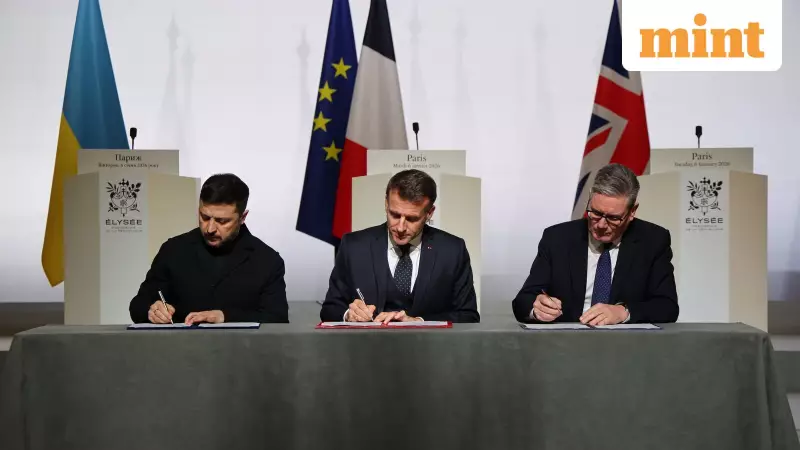
In a significant development aimed at ending the war, Ukraine's key allies have agreed to provide the country with robust, multilayered security guarantees. The agreement was reached during a crucial meeting held in Paris, which saw participation from top Western leaders.
Historic US Support and Summit Details
This summit marked the first time the United States explicitly backed the framework for these security guarantees. The US delegation was represented by Steve Witkoff and Jared Kushner. The meeting brought together leaders from various European nations, Canada, and high-level officials from the European Union and NATO.
Following the discussions, UK Prime Minister Kier Starmer expressed confidence, stating that "excellent progress" had been made. However, he tempered optimism with caution, noting that "the hardest yards are still ahead." Starmer emphasised that genuine peace is contingent on Russia's willingness to compromise, adding that President Vladimir Putin is not currently demonstrating readiness for peace.

Nature of the Security Guarantees
The collective commitment from the allies involves a comprehensive support package for Ukraine's defence. The leaders pledged to provide Kyiv's forces with extensive training, modern equipment, and coordinated air, land, and sea support. This multi-domain strategy is designed to deter any future aggression from Russia.
Prime Minister Starmer outlined specific measures, indicating that if a ceasefire is achieved, both the United Kingdom and France will establish military hubs across Ukraine. These hubs will include protected facilities to store weapons and military equipment, ensuring Ukraine's long-term defensive needs are met.
In a notable statement, French President Emmanuel Macron suggested that 'several thousand' French soldiers could be deployed to Ukraine following a signed ceasefire deal with Russia. Macron clarified that these would not be combat forces, but rather "a force of reassurance" to help maintain stability. The exact size of such a force and finer operational details remain unspecified.
Reactions from Moscow and Kyiv
Russia has maintained a guarded stance on the potential for a ceasefire, especially after the alleged Ukrainian attack on President Putin's residence. As of Tuesday, the eve of Orthodox Christmas, Moscow had not issued any specific comments on the Paris meeting.
Russian officials have consistently stated that a ceasefire is only possible after a comprehensive settlement is agreed upon. President Putin has also repeatedly warned against the deployment of troops from NATO member countries on Ukrainian territory.
Ukrainian President Volodymyr Zelensky acknowledged the progress made in the talks. He stressed the importance of the participating countries formally ratifying their commitments so that the guarantees can be implemented once a settlement with Moscow is reached.
"We determined what countries are ready to take leadership in the elements of security guarantees on the ground, in the air, and at sea, and in restoration," Zelensky said in a post-meeting news conference. "We determined what forces are needed. We determined how these forces will be operated and at what levels of command."
The Paris summit represents a concerted effort by Western allies to forge a concrete security architecture for Ukraine, linking it directly to a future peace process while preparing for a prolonged defence if necessary.






