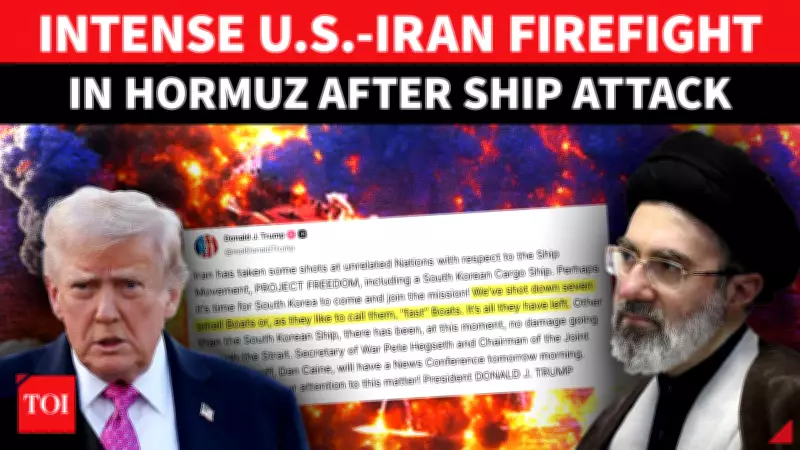
The month-long pause in hostilities has ended as a live shooting battle erupted in the Strait of Hormuz between the United States Navy and Iran's Islamic Revolutionary Guard Corps (IRGC). Admiral Bradley Cooper confirmed that U.S. Apache gunships and Seahawk helicopters destroyed six Iranian boats after they launched a coordinated 'swarming' attack using missiles and drones against American and commercial vessels.
Trump Confirms Destruction of Iranian Assets
President Donald Trump has confirmed the total destruction of seven Iranian assets, calling the move a necessary defense of 'freedom of navigation.' He stated that the United States will not tolerate threats to international shipping lanes and that the action was taken to protect both military and civilian vessels operating in the region.
Escalation in the Strait of Hormuz
The Strait of Hormuz, a vital oil chokepoint through which about 20% of the world's petroleum passes, has now become a direct war zone. The engagement marks a significant escalation in tensions that had been simmering since the previous truce. Iranian forces employed a swarming tactic, using fast attack boats armed with missiles and drones, but were repelled by superior U.S. firepower.

Global Implications
The conflict threatens to disrupt global oil supplies, with analysts warning of potential price spikes. The United Nations has called for an immediate de-escalation, while regional allies are closely monitoring the situation. Both sides have signaled readiness for further confrontation, raising fears of a prolonged conflict in the strategically critical waterway.
Related Developments
- Trump's administration has reportedly used emergency powers to send billion-dollar weapons to Middle East allies, bypassing Congress.
- Iran's IRGC has threatened to deploy unconventional tactics, including 'dolphin bombs' and mosquito fleets, against U.S. forces.
- Satellite images have revealed up to 40 Iranian attack vessels massing in the region, indicating preparations for further strikes.
The international community remains on edge as the world's most critical oil chokepoint becomes a theater of war, with no clear end in sight.