US-Iran Conflict Intensifies Amid Contradictory Diplomatic Signals
The ongoing military confrontation between the United States and Iran has entered a critical phase, with diplomatic communications from both nations presenting starkly opposing narratives. The situation remains volatile as hostilities show no signs of abating, threatening to engulf the broader Middle East region in sustained conflict.
Trump's Assertion: Iran Seeks Agreement but Fears Consequences
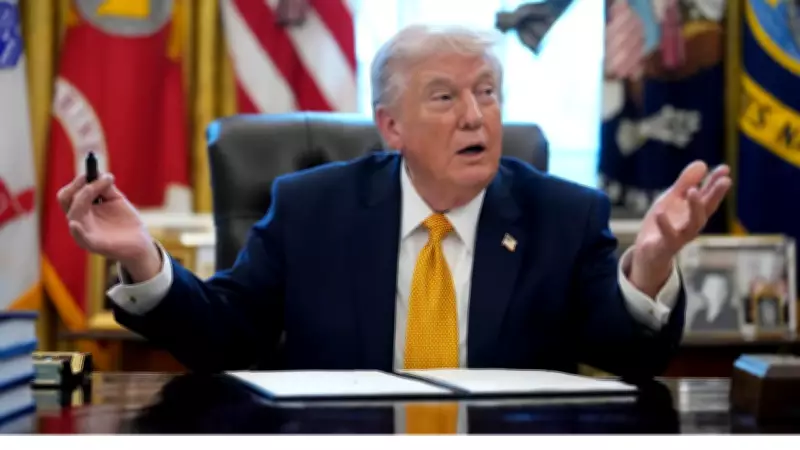
President Donald Trump has made a striking claim regarding Iran's position in the conflict, stating that Tehran desperately wants to reach a peace agreement but is paralyzed by fear. During a fundraising event for House Republican campaigns in Washington, Trump declared, "Nobody's ever seen anything like we're doing in the Middle East with Iran, and they are negotiating, by the way, and they want to make a deal so badly, but they're afraid to say it because they figure they'll be killed by their own people. They're also afraid they'll be killed by us."
This provocative statement comes as the White House maintains that discussions with Iranian officials continue to be productive, despite Tehran's public denials that any formal negotiations are taking place. The administration has acknowledged the existence of a comprehensive 15-point proposal aimed at resolving the conflict, which has reportedly been conveyed to Iranian authorities through Pakistani intermediaries.

Iran's Defiant Stance: Resistance Over Dialogue
Iranian Foreign Minister Abbas Araghchi has categorically rejected claims of ongoing negotiations with the United States, emphasizing that Tehran's current strategy is firmly rooted in resistance rather than diplomatic engagement. In a televised address, Araghchi dismissed suggestions of talks as premature and potentially indicative of weakness, stating that Iran's policy remains one of continued resistance against external pressure.
While acknowledging that indirect message exchanges have occurred through various channels, including friendly nations and individual mediators, Araghchi stressed that these communications do not constitute formal negotiations. He reinforced Iran's position that any resolution to the conflict must include ironclad guarantees against future attacks and appropriate compensation for damages incurred during the hostilities.
Military Escalation and Regional Expansion
The armed conflict has expanded significantly beyond its initial parameters, now involving multiple countries across the Middle East. Military engagements have been reported in Israel, Lebanon, and several Gulf states, with both sides claiming strategic successes. According to U.S. Navy Admiral Brad Cooper, head of Central Command, American forces have damaged or destroyed more than two-thirds of Iran's munitions production facilities, including missile, drone, and naval manufacturing sites.
Cooper emphasized in a released video statement, "We are on a path to completely eliminate Iran's wider military manufacturing apparatus." Satellite imagery analyzed by international agencies appears to corroborate these claims, showing extensive damage to Iranian military infrastructure from recent strikes.
Meanwhile, Iran has asserted that it has forced the repositioning of a U.S. carrier group in the region, while Israel continues targeting Iranian military assets. The conflict has drawn in regional actors including Hezbollah, further complicating the battlefield dynamics and increasing the potential for broader regional confrontation.
Strategic Waterways and Economic Implications
The Iranian parliament is advancing legislation that would authorize the collection of tolls from vessels transiting the strategically vital Strait of Hormuz. According to reports from Iranian news agencies, lawmakers are preparing a draft law that would require ships to pay fees for security assurances while navigating this critical maritime corridor.

A parliamentary official explained the rationale, stating, "This is completely natural. Just as in other corridors, when goods pass through a country, duties are paid; the Strait of Hormuz is also a corridor. We ensure its security, and it is natural for ships and tankers to pay its duties." This development represents one of five conditions Iran has outlined for potentially ending the conflict, reflecting Tehran's determination to assert control over this crucial waterway through which approximately one-fifth of the world's oil passes.
International Concerns and Diplomatic Efforts
United Nations Secretary-General Antonio Guterres has issued a grave warning about the escalating conflict, expressing concern that the situation risks spiraling "out of control." The potential disruption to global energy supplies and economic stability has raised alarms internationally, with particular focus on the security of vital shipping lanes including the Strait of Hormuz and potentially the Red Sea.
Despite the public posturing and military escalation, both sides appear to be pursuing parallel tracks of pressure and diplomacy. The reported 15-point U.S. proposal, conveyed through Pakistani channels, addresses multiple contentious issues including Iran's nuclear program, ballistic missile capabilities, and maritime security arrangements. However, with neither Washington nor Tehran willing to publicly concede ground, the gap between rhetoric and reality continues to fuel uncertainty about how and when this dangerous conflict might be resolved.
Key Developments in the US-Iran Conflict
- President Trump claims Iran wants to negotiate but fears retaliation from both its own population and U.S. forces
- Iranian Foreign Minister Araghchi categorically rejects claims of ongoing negotiations with the United States
- U.S. military reports destroying over two-thirds of Iran's munitions production facilities
- Iranian parliament preparing legislation to collect tolls for Strait of Hormuz passage
- Conflict expands regionally with involvement of Israel, Hezbollah, and Gulf states
- UN warns situation risks spiraling "out of control" with global economic implications
- Reported 15-point U.S. peace proposal conveyed through Pakistani intermediaries
- White House maintains talks are "productive" despite Iranian denials