

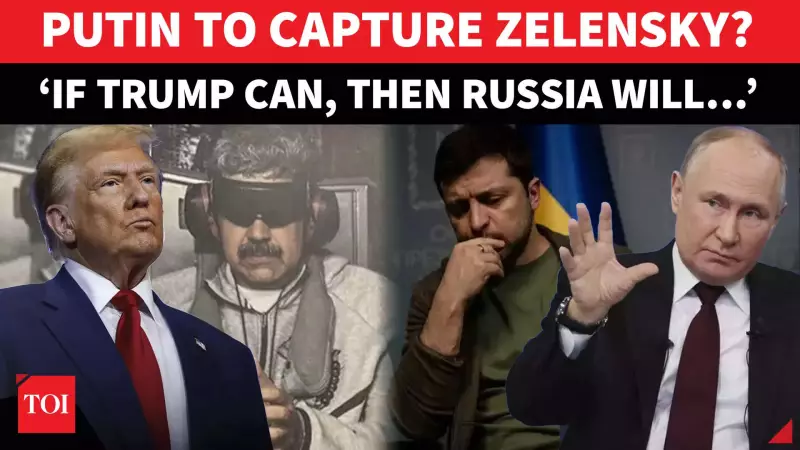
A chilling new warning has emerged from Moscow, directly linking the recent dramatic capture of Venezuelan President Nicolás Maduro by the United States to the ongoing conflict in Ukraine. A key Kremlin figure has suggested that the same tactics could potentially be used against Ukrainian leader Volodymyr Zelensky, escalating global tensions.
Medvedev's Stark Precedent Warning
The warning was issued by Dmitry Medvedev, a senior Russian security official and former president. He stated that the U.S. operation against Maduro, which reportedly occurred recently, establishes a dangerous global precedent. Medvedev argued that if Washington can detain a foreign head of state, the same justification could be applied in other geopolitical theatres. "We can also..." he ominously hinted, leaving the threat unfinished but clear in its implication.
Medvedev specifically targeted Ukrainian President Volodymyr Zelensky, reiterating Moscow's long-standing position that his legitimacy is contested under the current wartime conditions. This rhetoric forms a core part of Russia's narrative justifying its military actions in Ukraine.

Europe's Muted Response Adds Fuel to the Fire
Russia has also pointed a finger at Europe, claiming that the continent's relatively muted reaction to Maduro's detention only amplifies the risk. The Kremlin's message is unambiguous: the crisis that began in Venezuela will not remain confined to Latin America. Its repercussions are now echoing in Eastern Europe, potentially reshaping the rules of international engagement.
The original report, dated January 06, 2026, highlights how a single event in one part of the world can send shockwaves across the globe, creating new diplomatic and strategic dilemmas.
Global Implications and a New Era of Brinkmanship
This development signals a potentially new and volatile phase in international relations. The explicit comparison drawn by a Russian official between Venezuela and Ukraine suggests a readiness to frame any future actions within a tit-for-tat logic. It raises profound questions about the sanctity of national sovereignty and the limits of power projection in the 21st century.
Analysts suggest that such statements are designed to test Western resolve and create psychological pressure. The situation demands close observation as world leaders navigate this increasingly complex and confrontational landscape.






