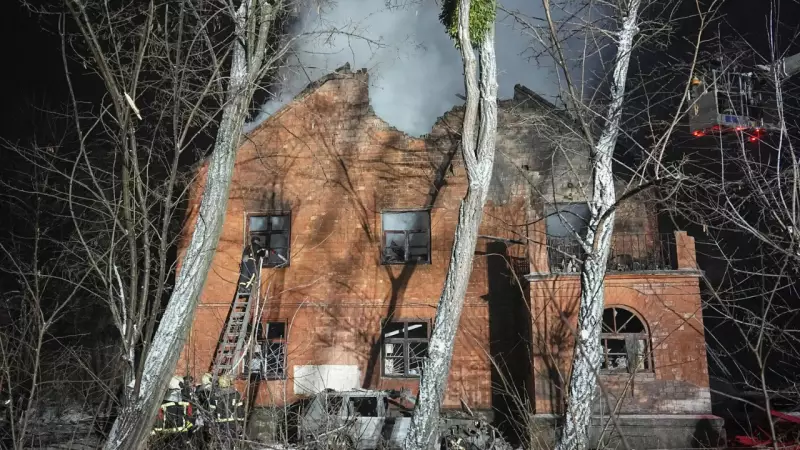
In a significant escalation of hostilities, Russia launched a large-scale overnight assault on Ukraine, employing advanced hypersonic missiles and hundreds of drones. The attack, which Ukrainian authorities say killed at least four people in the capital Kyiv, has drawn sharp international condemnation and raised alarms over European security.
Massive Overnight Barrage and Russian Retaliation Claim
Russia's defence ministry stated on Friday that its forces struck what it called "strategic targets" in Ukraine using Oreshnik hypersonic missiles. While the ministry withheld specific details on the locations or scale of the impact, it framed the operation as a direct retaliation for a December drone strike. Moscow claims that earlier attack targeted a residence of Russian President Vladimir Putin, an allegation Ukraine has consistently denied.
Ukrainian officials provided a starkly different account of the night's events. They reported that Russia launched a total of 36 missiles and 242 drones across the country. This massive aerial bombardment set apartment blocks ablaze, damaged residential buildings, and critically impacted infrastructure. The assault followed Moscow's rejection of a latest post-war peacekeeping plan proposed by Kyiv and its allies.

Civilian Casualties and Infrastructure Damage in Kyiv
The human cost of the attack was felt most acutely in Kyiv. According to Tymur Tkachenko, head of the Kyiv City Military Administration, the strikes killed four people and injured at least 22. Among the deceased was an emergency medical worker. Ukraine’s security service added that five rescue workers were injured while responding to attack sites.
Mayor Vitali Klitschko reported that multiple districts of the capital were affected, with disruptions to water supply and electricity. In the Desnyanskyi district, a drone crashed onto the roof of a multi-storey building. Elsewhere, the first two floors of a residential building were damaged, and in the Dnipro district, falling debris from a downed drone triggered a fire. The attack occurred just hours after President Volodymyr Zelenskyy warned that Russia was planning a major new offensive, potentially seeking to exploit freezing conditions in the capital.
Cross-Border Strikes and Warnings to the West
The conflict's ripple effects were felt on Russian soil as well. The governor of Russia's border region of Belgorod, Vyacheslav Gladkov, announced that a Ukrainian attack on utility infrastructure had knocked out services for a vast population. As of 6:00 am on Friday, 556,000 people across six municipalities were without power, with a nearly identical number lacking heating as temperatures hovered near freezing.
Meanwhile, Ukraine's foreign minister issued a grave warning to its Western allies, noting that the Oreshnik missile strike landed perilously close to the EU and NATO border. He characterized the attack as a "grave threat" to European security and called it a deliberate 'test' for Kyiv's international partners. The strike also targeted critical infrastructure in the western Ukrainian city of Lviv, with Mayor Andriy Sadoviy confirming the use of an unidentified ballistic missile.
This latest exchange of heavy strikes underscores the intensifying nature of the war, with both sides demonstrating a willingness to target energy and civilian infrastructure, leading to significant casualties and escalating the humanitarian crisis.