

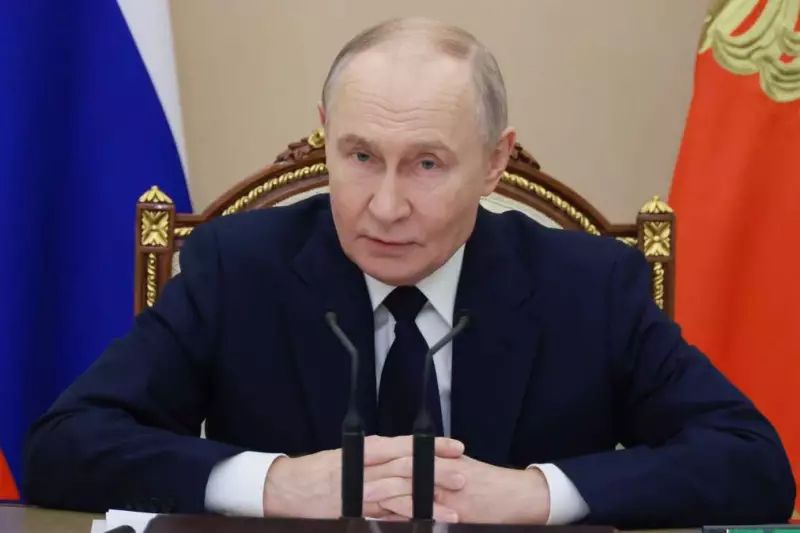
In a dramatic escalation of rhetoric, Russia has publicly accused Ukraine of attempting a direct attack on President Vladimir Putin's official residence. The serious allegation was made by Russian Foreign Minister Sergey Lavrov during a high-profile press conference, marking a new phase in the war of words between the two nations.
Lavrov's Serious Allegation
Russian Foreign Minister Sergey Lavrov stated that Ukrainian forces tried to target President Vladimir Putin's residence using unmanned aerial vehicles. He presented this claim as evidence of what he termed Kyiv's "terrorist methods". The minister made these remarks during an annual press conference held in Moscow, where he summarized Russia's foreign policy stance for the year.
Lavrov did not provide specific evidence regarding the alleged attack attempt, such as the exact date or the type of drone used. However, he framed the incident within the broader context of the ongoing conflict, suggesting it was part of a pattern of aggressive actions by Ukraine. The Russian foreign minister's statement is seen as a significant effort to shape the international narrative around the war.

Context and Immediate Reactions
This accusation comes amidst a period of heightened military activity and public posturing. The alleged attempt on Putin's residence, a heavily fortified and symbolic location, represents a serious charge that, if proven, would cross a major red line. Historically, attacks on the personal security of a head of state are considered grave escalations.
As of now, there has been no immediate official response from Ukrainian authorities regarding Lavrov's specific claim. Ukraine has consistently denied targeting civilian locations and has previously accused Russia of fabricating narratives to justify its own military actions. The international community is likely to scrutinize these claims closely, given their potential to further inflame tensions.
The press conference where Lavrov made the allegation covered a wide range of topics, but this point stood out for its direct and personal nature. By focusing on an attack against the president's home, the Russian narrative aims to personalize the conflict and portray Ukraine as engaging in illegitimate warfare.
Broader Implications for the Conflict
Analysts suggest that such accusations serve multiple purposes for the Russian leadership. Firstly, they are intended to demonize the Ukrainian government and military in the eyes of both the Russian public and the international community. Secondly, they can be used to justify more aggressive retaliatory measures by Russian forces, potentially against Ukrainian command centers or political leadership.
The use of drone technology has become a hallmark of this conflict, with both sides employing unmanned systems for reconnaissance and strikes. An alleged attempt to use this technology against the pinnacle of Russian state power underscores the evolving and asymmetrical nature of modern warfare.
The key facts from the report are:
- The accusation was made by Russian Foreign Minister Sergey Lavrov.
- The alleged target was President Vladimir Putin's official residence.
- The claimed method was an attack using unmanned aerial vehicles (drones).
- Lavrov made the statement during his annual press conference in Moscow.
- He labeled the alleged attempt as an example of "terrorist methods" by Ukraine.
This development adds another layer of complexity to an already volatile situation. It raises the stakes in the information war that runs parallel to the physical battlefield. The world will be watching for Ukraine's response and for any corroborating or contradicting evidence that may emerge from intelligence sources. For now, Lavrov's claim stands as a potent accusation that seeks to reframe the conflict's narrative and justify Russia's ongoing military campaign.






