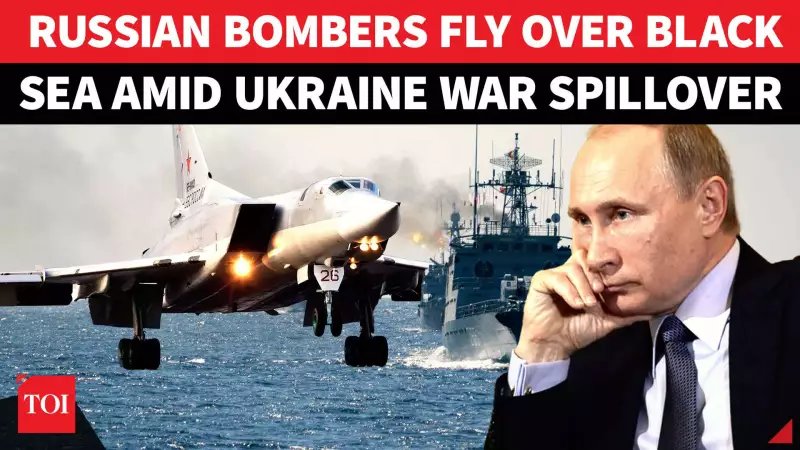
In a move that has significantly heightened military tensions in Eastern Europe, Russia has deployed its formidable Tu-22M3 long-range strategic bombers for a flight over the Black Sea. The mission, which took place on December 17, 2025, brings these advanced aircraft perilously close to NATO airspace, raising alarms amidst the ongoing conflict in Ukraine.
Moscow's Stance: A Routine Training Flight
The Russian defence ministry was quick to frame the operation as a standard procedure. Officials stated that the Tu-22M3 bombers conducted a scheduled flight over international waters of the Black Sea, strictly adhering to international rules for airspace use. They emphasised that the aircraft did not violate any national borders and that the mission was part of regular, long-range aviation training exercises for the Russian Aerospace Forces.
Despite these assurances, the timing and location of the flight are viewed with deep suspicion by Western military analysts. The Black Sea has become a critical flashpoint since Russia's full-scale invasion of Ukraine, with frequent naval engagements and drone attacks. The deployment of strategic bombers, capable of carrying both conventional and nuclear payloads, is seen as a power-projection move by the Kremlin, directly testing NATO's resolve and monitoring capabilities in the region.

A Region on Edge: The Broader Black Sea Context
This aerial provocation does not occur in a vacuum. The Black Sea region remains a cauldron of military activity. Recent weeks have seen reports of explosions targeting ships in the area, further destabilising crucial maritime trade routes and heightening the risk of a broader confrontation. The presence of Russian bombers adds a new, more threatening dimension to an already volatile situation.
For NATO members like Romania, Bulgaria, and Turkey, which border the Black Sea, the flyover is a direct security concern. It compels the alliance to reassess its air defence posture in the region. The incident also underscores the challenges in establishing a stable security architecture over the Black Sea, where incidents or miscalculations could rapidly escalate.
Implications and the Path Ahead
The strategic message behind the bomber deployment is multifaceted. Primarily, it serves as a demonstration of Russia's continued military reach and readiness, even as its forces are engaged in a gruelling war in Ukraine. It is a reminder to the West that Moscow retains significant capabilities to project force beyond the immediate Ukrainian battlefield.
Secondly, it acts as a pressure tactic, likely aimed at influencing Western support for Ukraine by showcasing the potential for the conflict to spill over. Analysts suggest such manoeuvres are designed to sow doubt and caution among NATO members about the risks of further military aid to Kyiv.
The international community, particularly NATO, is now faced with calibrating its response. While a direct military response to a flight in international airspace is unlikely, the alliance is expected to increase its surveillance and possibly conduct its own demonstration flights or naval exercises in the area to affirm its commitment to collective defence. The incident makes clear that the war in Ukraine continues to have dangerous ripple effects, with the Black Sea remaining a key theatre for geopolitical standoff.