

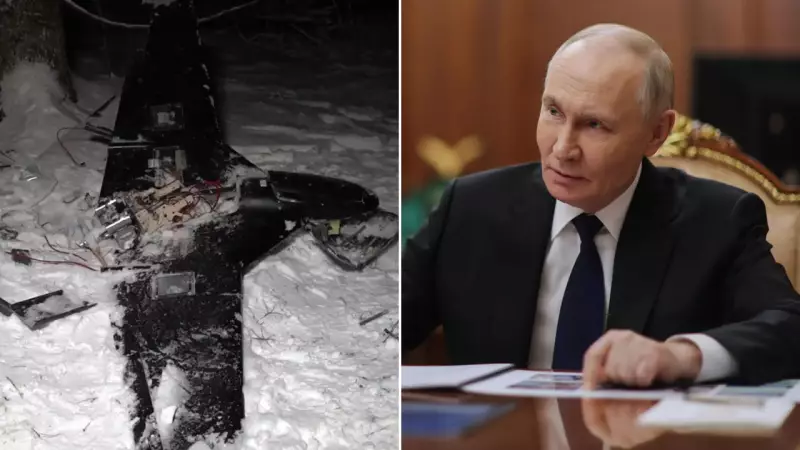
In a dramatic escalation of rhetoric, Russia's defence ministry has released night-time footage purportedly showing the wreckage of a Ukrainian drone shot down near one of President Vladimir Putin's secretive residences. The incident, alleged to have occurred in northwest Russia, has reignited tensions at a delicate moment in peace negotiations concerning the ongoing war in Ukraine.
The Alleged Attack and Moscow's Claims
Moscow described the event as a targeted "terrorist act" and a "personal attack" on President Putin. The defence ministry stated the drone was intercepted during what it called a "mass launch" of unmanned aerial vehicles targeting the presidential residence in the Novgorod region on the night of December 28–29. According to Russian officials, a total of 91 drones were launched that night, all of which were reportedly intercepted by air defence systems.
The published video shows a damaged drone lying in snow within a wooded area. The ministry claimed the intercepted device carried a six-kilogram explosive charge but asserted that the residence itself suffered no damage. Kremlin spokesperson Dmitry Peskov stated that no further evidence would be provided, arguing proof was unnecessary since all drones were allegedly destroyed.

The Russian defence ministry characterised the alleged strike as "targeted, carefully planned and carried out in stages." The exact location of Putin at the time remains undisclosed, with officials citing security concerns. While the locations of Putin's residences are typically state secrets, past investigations by opposition figures have indicated a heavily guarded lakeside compound in the Novgorod region.
Ukraine's Firm Rejection and Diplomatic Fallout
Ukraine has categorically rejected the allegations. President Volodymyr Zelenskyy dismissed the claim as "a complete fabrication," suggesting it was designed to manipulate ongoing diplomatic efforts. Kyiv has pointed to a lack of plausible evidence and accused Russia of creating a pretext for further attacks on Ukrainian cities, including the capital.
"Our negotiating team connected with the American team, went through the details, and we understand that it’s fake," Zelenskyy told journalists, urging international partners to independently verify Russia's story. Ukrainian Foreign Minister Andrii Sybiha echoed this, stating Russia was spreading falsehoods to undermine progress toward a lasting peace.
International Reactions and Peace Talk Implications
The allegation surfaced amid renewed diplomatic activity, following a meeting between Zelenskyy and former US President Donald Trump in Florida. Trump revealed that Putin had personally informed him of the alleged attack. He criticised Kyiv, stating it was "not the right time" for such actions. When questioned on the possibility of fabrication, Trump expressed uncertainty but noted Putin's insistence that the event occurred.
This reported incident comes as Trump has claimed a peace deal is "95% done," and Ukraine says it has agreed to most elements of a US-drafted plan. However, Russia has signalled a potential shift, with Foreign Minister Sergei Lavrov stating that retaliatory targets in Ukraine had already been selected and that Moscow might now "revise" its negotiating position. This development threatens to further complicate the already fragile peace process.






